
How My Content Marketing Strategy Helped IT Support Services to Increase Leads by 900%
It’s not unusual for IT support providers with a blog to generate traffic using a content marketing strategy.
The issue with most content marketing, however, is that they generate traffic but not qualified leads.
In six months, I increased the leads of an MSP by 900%. That sounds too high to be true, but it’s what the screenshot below reveals.
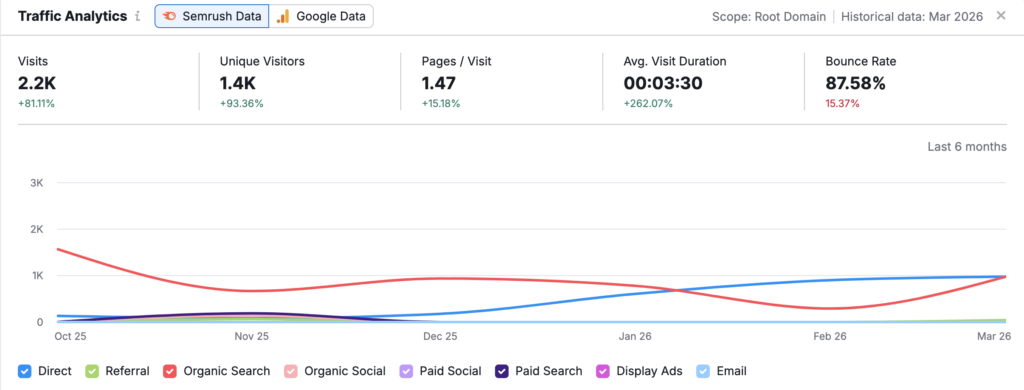
If you take a look at the blue wavy line at the bottom of the graph, you will see there were around 100 direct visitors returning to the website in October.
My first post for this client was published on 13th October. The title: Cybersecurity Risks for Overseas Firms with UK Offices and How to Prevent Them

Have a read if you wish. There’s a link embedded in the title.
Before you shoot off, though, you probably want to know how I improve qualified leads.
You will find the insights into my content marketing strategy in this piece of content: Want More Conversions? A Content Marketing Strategy For MSPs.
And just in case you are wondering what the other metrics measure, I’ve listed a brief breakdown below.
This might help you to get your head around how to create a content marketing strategy for your MSP.
Content Marketing Strategy: Stats
As you can see from the content marketing strategy statistics above, SEMRush measures several key indicators.
-
- Visits — which increased by 81.11%
-
- Unique visitors — which increased by 93.36%,
-
- Page views — which increased by 15.18%,
-
- Bounce rate — which decreased by 15.37%
-
- Direct — which grew from roughly 100 monthly visitors in October 2025 to over 1,000 by March 2026
These metrics, tracked through SEMrush, tell a clear story:
A solid content marketing strategy works — not just in terms of increased visibility, but of improved relevance, engagement, and brand recognition.
Content Strategy Stats: The Breakdown
To understand the significance of these outcomes, it’s important to break down what each metric actually represents and how it was influenced.
Visits
In SEMrush, visits refer to the total number of internet users visiting your website. This includes new visitors and repeat visits by a previous user.
An 81.11% increase indicates that not only are more people finding the site, but people who have been are returning.
This metric indicates that your SEO strategy is working, and also that you are publishing high-quality content people want to read.
I achieved an increase in visits by building a content strategy around keywords aligned with search intent — targeting high-value keywords across the awareness, consideration, and decision stages of a typical buyer journey.
Technical SEO improvements (site speed, indexing, internal linking) ensured that content was discoverable and performant.
Check out this SEMRush article for technical SEO tips.
Unique Visitors
This metric is a count of individual users visiting the website — 1.4K in 6 months — a 93.36% increase from the previous six months.
An increase in unique visitors shows new audiences are entering the ecosystem and suggests strong top-of-funnel growth.
This was driven primarily through organic search expansion: publishing authoritative, niche-specific content that addressed real business pain points (e.g., cybersecurity risks, downtime costs, compliance exposure).
By targeting long-tail queries with commercial relevance, we captured users earlier in their research phase looking for answers.
Page Views
Page views record the average number of pages that a single visitor views during a session. Although a modest number, this metric reveals something important: users were more intentional.
Rather than aimless browsing, they were landing on relevant pages and engaging with purpose. This was achieved through tighter content architecture, clearer navigation, and strong internal linking between related topics.
Each page served a defined role in the buyer journey, reducing friction and unnecessary clicks. The increase of 15.18% compared to previous months also reveals that more visitors are exploring the website — which is also demonstrated by the next metric.
Bounce rate
This metric reflects the percentage of users who leave the site after viewing only one page. A high bounce rate is not good because it indicates low engagement — which means no leads.
A 15.37% reduction in bounce rate is a strong signal of improved engagement.
This came down to alignment: ensuring that what users clicked on in search results matched exactly what they found on the page.
Lowering bounce rate through a content marketing strategy involves writing better headlines, framing, clearer value propositions which immediately address user intent.
Additionally, embedding contextual calls-to-action and linking to relevant supporting content encouraged deeper exploration on other pages.
This strategy is also important for SEO because search engines add more weight to pages that provide value — and directing users to additional information is considered to be valuable.
What Do You Want From Your Content Marketing Strategy?
Direct traffic
In SEMrush, direct traffic refers to users who arrive by typing the URL directly, using bookmarks, or via untracked sources.
Growth from 100 to 1,000 monthly visitors is a major indicator of brand lift.
This doesn’t happen through SEO alone — it’s the byproduct of sustained visibility, content that offers value and user trust.
As the MSP consistently appeared in search results, users began to remember and return to the brand directly.
In addition, we send content which provides valuable insights to businesses in the MSPs’ email list and to their social media following.
These numbers are hot leads with both feet in your sales funnel. Direct visitors are the people you are developing a relationship with.
They are the prospects that could become clients.
They are clients you want to retain.
The number of Direct visitors you have is an indication that your content marketing strategy is more than a lead generation tool — it’s a path to client acquisition.
A content strategy that elevates your brand image gives you more equity in the market.
Do You Want A Content Marketing Strategy That Drives Conversions?
The takeaway is straightforward: traffic growth alone is a vanity metric.
By improving all of these metrics in parallel, you don’t simply attract more visitors — you attract the right visitors, and give them a reason to stay.
You will find the insights into my content marketing strategy in this piece of content: