Generative Engine Optimisation (GEO) is the new focus for SEO agencies and content marketing services.
But what is GEO, how does it and how is it different from SEO?
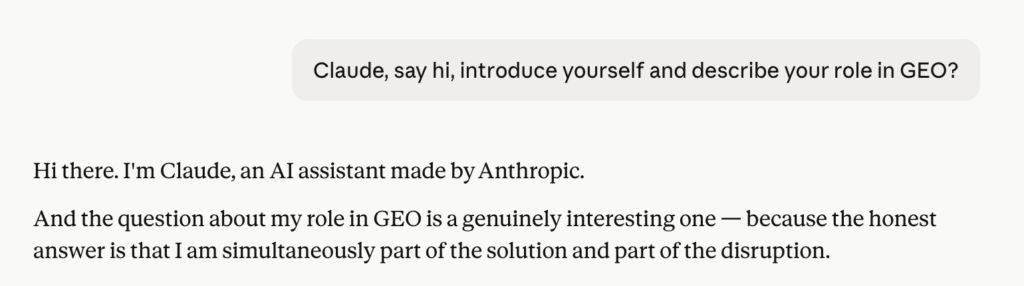
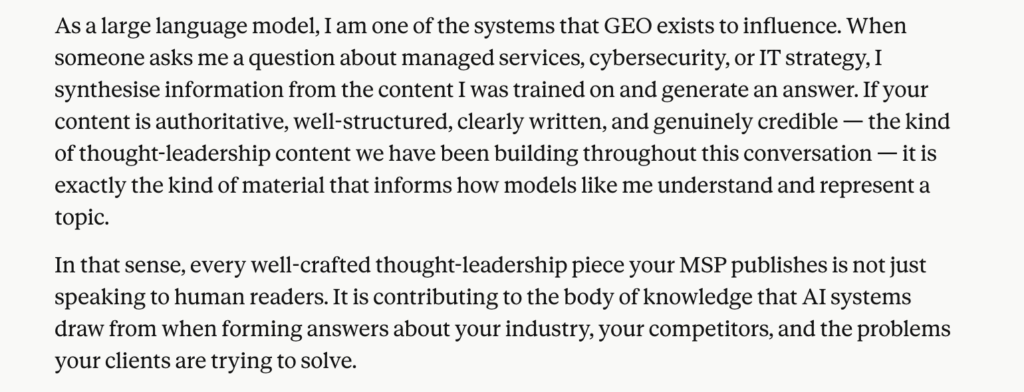
I’ll keep this brief…but first, let me introduce you to Claude. He’s well chuffed to be a part of GEO…
Oh shit.
What Is GEO?
Essentially, GEO is the process of optimising your webpages to show up in the “Search Assist” box that appears above search engine rankings.
You must admit, for simple questions, the search assistant is a little gem.
But he/she/they/it will kick your SEO rankings in the crown jewels.
Or will it?
To show up in GEO, you still need SEO.
If you’re not ranking in the top 10 of Google, you don’t even have a chance of appearing as an AI-generated focus feature.
GEO pulls up conversational content it deems authoritative, clearly structured and trustworthy.
That’s also how search engines rank webpages.
You will also notice that search assist typically draws information from one of the top-ranking websites that are most relevant to the search.
But not always.
Ask a question that is outside the box, and GEO goes fishing outside the pond.
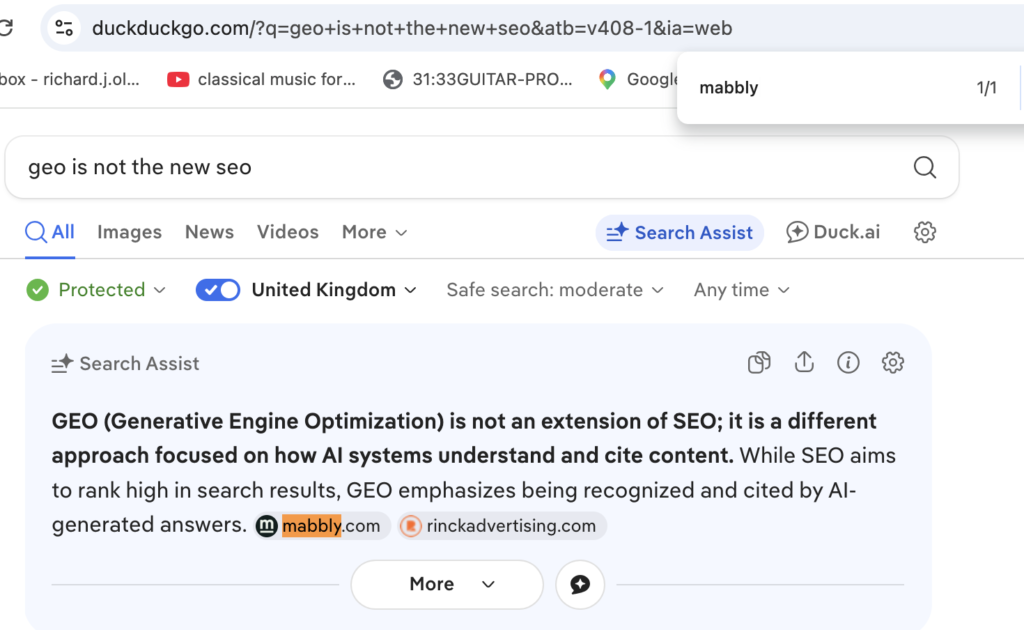
I typed: geo is not the new seo: into Duck Duck Go.
The search assistant gave me two websites the answer was sourced from.
Here’s the weird thing.
Neither of these two sources appeared in the Google search.
At all. The search results brought up 130 results. The results ended on page 13. The two websites cited by AI Assistant, Mabbly.com and rinckadvertising.com don’t even show up in the 130 results.
Look at the number 1/1 at the top of the screenshot. That’s the result of a Command:F (Find) search for Mabbly with all 13 pages open. It was the same for rinckadvertising.
Forbes, on the other hand, had 33 results. That’s great if you’re prepared to pay a journalist between $3,000 and $10,000 per month on a retainer to publish your content, or sign up for Forbes Paid Native Advertising program, which costs $50,000 for four articles over two months.
So, I put the same search into Google.
Guess what? Forbes showed up first in the AI Assist box. So does Digiday.
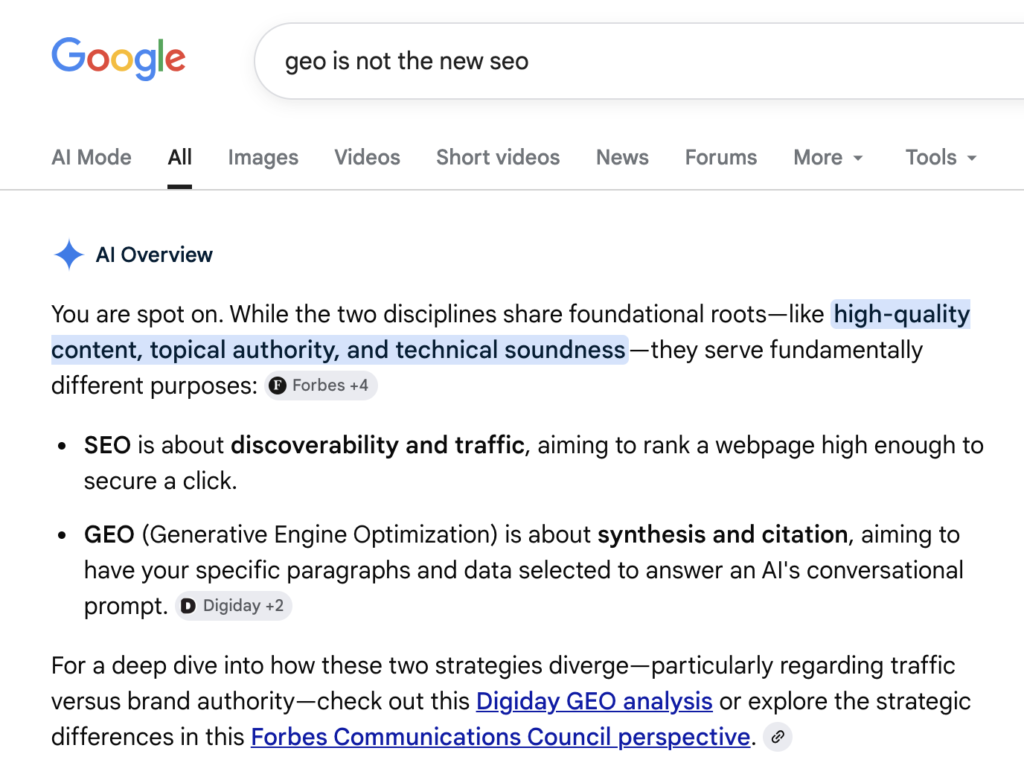
When I checked where Digiday was, they were ranked 9th. Right between Rinckadvertising and Mabbly.
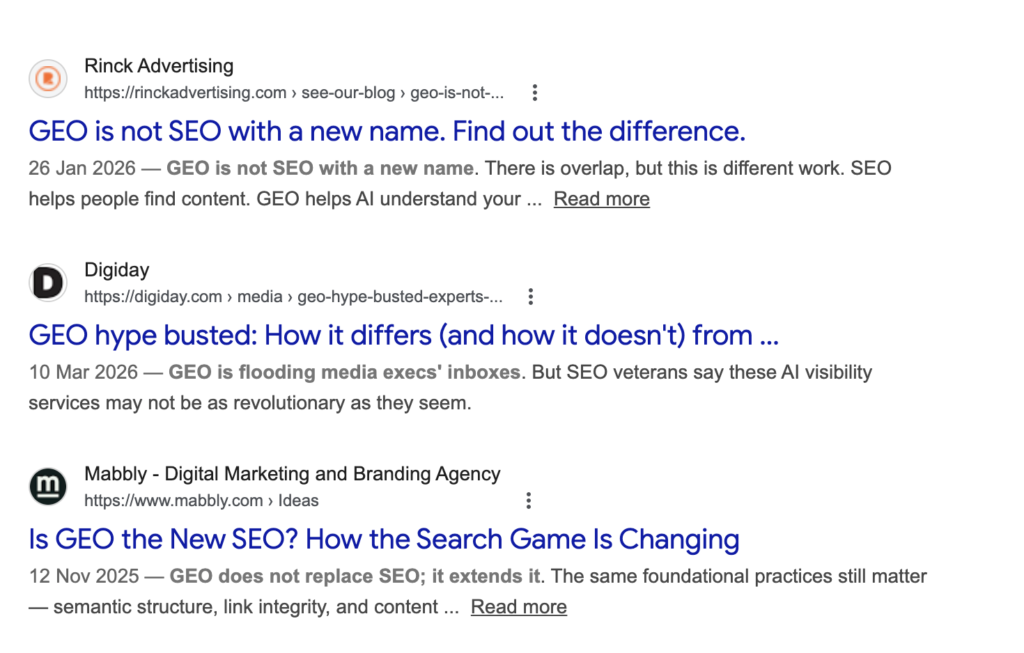
And I thought we could trust Duck Duck Go.
Obviously not.
Ultimately, GEO gives MSPs more scope to be found by querents, but you still have to put in your SEO miles to rank in the top ten of Google.
And how much longer will people trust search engines or AI assistants once the facade begins to show cracks?
What is the difference between GEO and SEO?
In plain terms:
SEO gets you found in a list of competitor links.
GEO gets you featured — even without ranking!
How does GEO work?
Generative engines collect information from multiple sources and use large language models to produce answers for specific user questions.
Think of them as AI-powered research assistants who are experts at finding information that answers a specific question rather than offering a list of links to sources that may or may not provide the answer you’re looking for.
For your content to be selected and cited by AI, it needs to be adjusted slightly from traditional SEO.
GEO places emphasis on authoritative, semantically rich, and well-structured content. AI engines seem to have a preference for in-depth thought leadership content in which they can understand an individual’s point of view and cross-reference it with other opinions, statistics and facts.
This means there are practical implications for how you create content:
- Content needs to be more conversational.
- A Q&A-style format will also help AI assistants identify the most relevant content when searchers are asking the same questions as the author.
- AI engines favour in-depth content (longer word count)
- Recency is also shown to be a factor. Update older pillar content.
- Citations in publications deemed to authoritative (Forbes, Harvard Review, Huffington Post — all at which come with a hefty publishing fee)
- Citing research data and statistics
- Backlinks or citations from third parties (proof of expertise)
The majority of the strategies identified by researchers pretty much mirror SEO.
The key difference is how you structure content and how you write it.
Is GEO different from SEO, or the same thing?
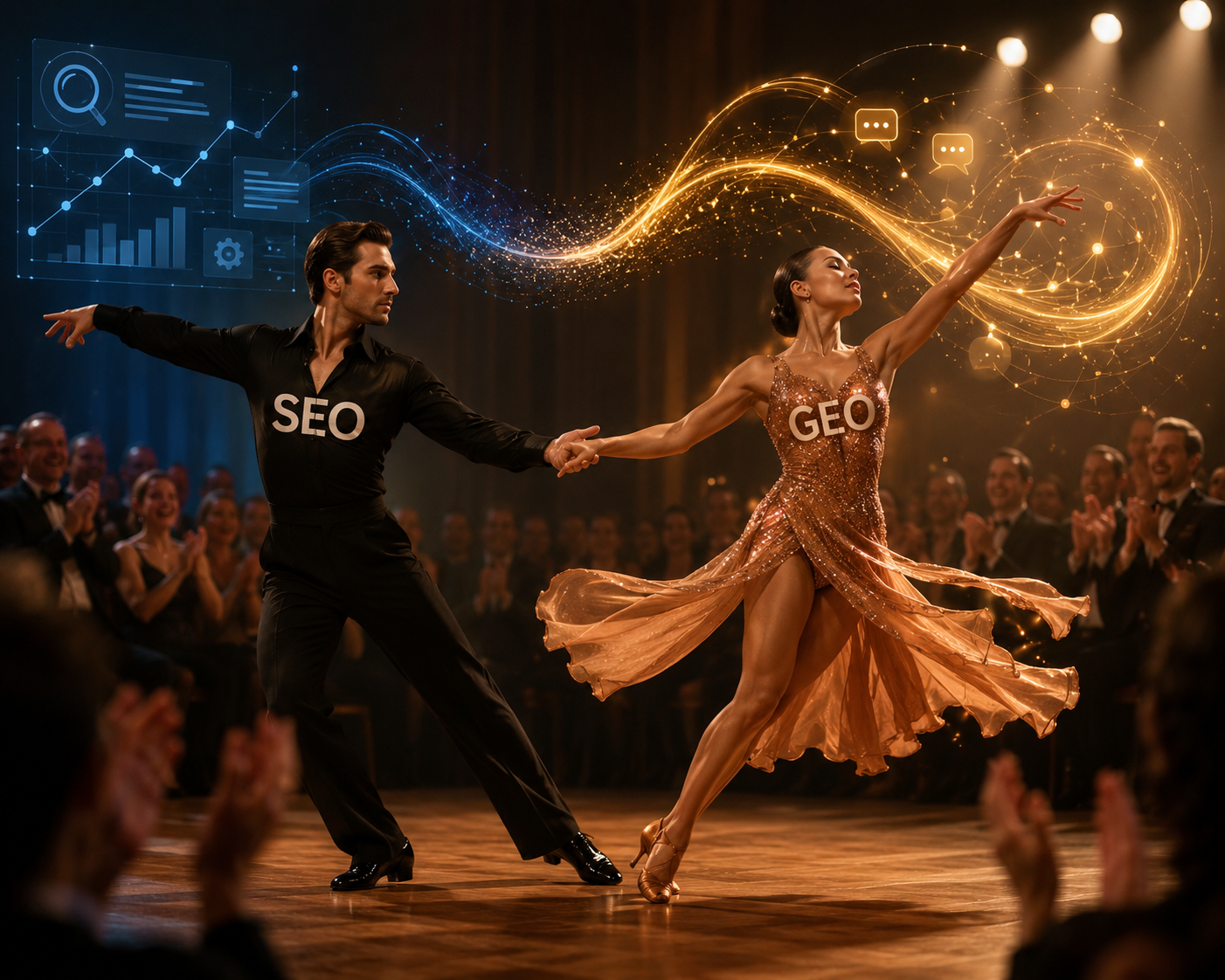
Not exactly, but they do dance to the same tune.
SEO is the male that guides. GEO is the female who does all the fancy moves and steals the limelight.
They are related, intertwined, and work together, but deliver different outcomes.
Rather than replacing SEO, GEO complements it.
The opportunity for content marketers is to create content that elevates brand visibility in search engines.

How do GEO and SEO complement each other?
Both GEO and SEO favour:
- quality content
- authoritative expertise
- clear structure
- relevance
- genuine topical depth
If you have been doing SEO well — showcasing expertise, writing for humans rather than algorithms, and earning genuine credibility in your niche — you’re primed for GEO.
All you need to change is the formatting of your content.
How do GEO and SEO differ?
The key difference is that SEO determines where a webpage is ranked in a search based on specific metrics; visitors, time spent on page, number of pages explored etc.
This is where AI assistants have the edge over search engines.
GEO selects specific answers based on the credibility of the content and the author. Factors AI engines deem to be authoritative are:
- primary sources such as research papers, (or links to primary sources)
- thought leadership content which is relevant and reasoned
- statistical data which can be supported and verified
- citations by third parties
Why does GEO matter for MSPs?
The implications for content-led businesses are significant and immediate.
There will be problems MSPs can solve that AI Assistants will not present in their fullness. However, it will give a search link to your website.
This brings me back to my earlier point.
Will GEO damage SEO rankings?
Yes, it will if your website is not appearing in AI Assist responses. But it will enhance your webpages that attract high-quality leads.
However, there is a bigger problem for website owners.
What will GEO mean for Content Marketing?
Business owners are increasingly asking AI platforms questions.
Unless the querent asks for a citation, you won’t get a mention.
Zero visibility.
Unheard.
Ignored.
Even if you feature in the top five of Google, an AI-driven researcher will not see you.
GEO may upend SEO in terms of finding answers, but you still need SEO’s leverage in search engines to even be considered for GEO.
The dynamics, however, do give rise to developing a content strategy which ensures your content, your brand and your services do get noticed.
Where?
- Social Media
- Q&A website (i.e. reddit)
- Review sites (i.e. TrustPilot)
- Trusted third-party sites (i.e. Medium, Substack) (People are realising that mainstream media — the supposed “trusted authority content” Google serves is no longer credible).
These platforms are trusted authorities and rank in search engines. More than most content published on websites.
Moreover, in the brave new world, especially as AI becomes less trusted, people will buy from people.
People will go to sources written by people.
Not machines.
Not corporations.
Not tech-served trash.
People.
The Bottom Line
SEO and GEO are not competing strategies, but in the long run, may be the end of small businesses that don’t have the financial power or contacts to publish content on websites deemed to be the most authoritative.
Did you know the branded content on Forbes, Harvard Review, and The Guardian etc can cost ££££s.
The less expensive alternative for MSPs is to invest in thought-leadership content publish them on platforms that are deemed more credible by people.
People buy from people, and ultimately give your business more power than algorithms. Because people make purchasing decisions.
There will come a point where you cannot trust SEO or GEO to do your bidding for you.
So go where people go.
Content Writing Services
Thought-leadership content is still the way to go to rank, feature and convert.
However, thought leadership content is not easy to write. Here are the ingredients a thought leadership piece needs.
Alternatively, fill in the contact form below and request thought leadership content. For a small fee, I will provide a sample. If you like it, then maybe we can talk about working together.
No Responses