
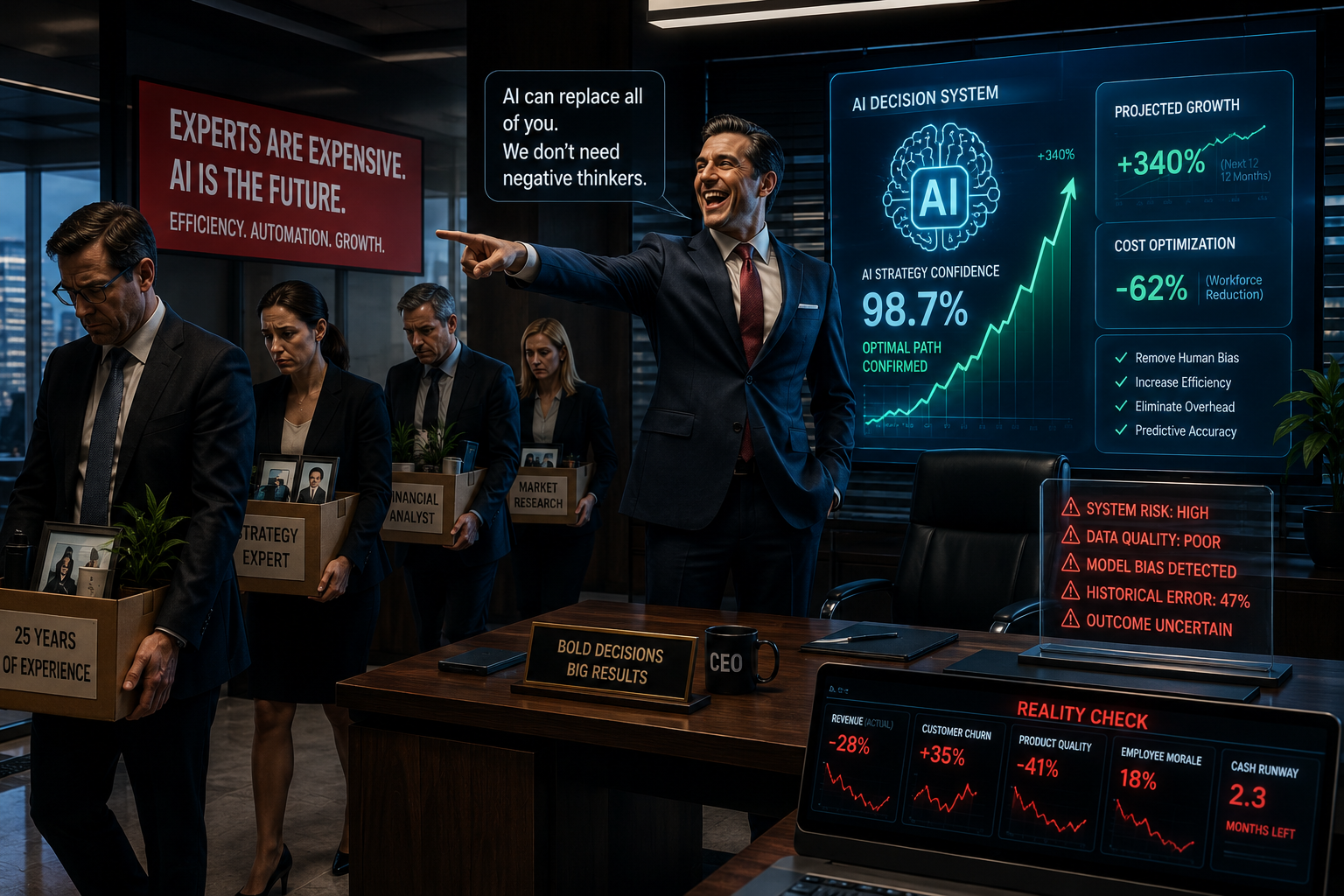
There is an AI problem quietly eroding businesses right now.
It’s not the problem most people are talking about:
Job displacement.
Data privacy.
Algorithm bias.
It’s not even the question of whether AI will eventually outthink us.
It’s subtler, more immediate, and in many ways more dangerous than any of the headline conversations.
AI is inflating confidence faster than it’s building competence.
And the gap between those two things — between how capable organisations believe they are and how capable they actually are — is widening every single month.
The Data Damage You May Not Be Seeing
For most of the last two decades, the primary challenge facing businesses in relation to technology was access.
Access to expertise and strategic insight that historically lived inside expensive consulting agencies, senior hires, and decades of hard-won operational experience.
If you wanted to understand something deeply, you had to earn that knowledge through experience.
If you wanted to produce something of genuine quality, you needed the expertise to create it yourself or the budget to pay a specialist.
The knowledge barrier kept a natural order to the dynamics of b2b interactions.
AI has dismantled that barrier.
Now any business, regardless of size, budget, or internal capability, can generate reports that read as if they came from a Big Four consultancy.
Or, at least they appear to.
At first glance, AI content looks like an equaliser.
But beneath the polished surface, something unsettling is taking shape.
Confidence Has Become Decoupled From Capability
Accessing information is no longer a problem.
AI has the skills of a seasoned professional.
However, in some aspects of business, the quality of information AI is producing for businesses is questionable.
And poor quality information will result in poor quality results, which could cause more damage in the long-term than the solutions it’s fixing in the here and now.
As a case in point, you might want to take a look at this article.
I asked ChatGPT:
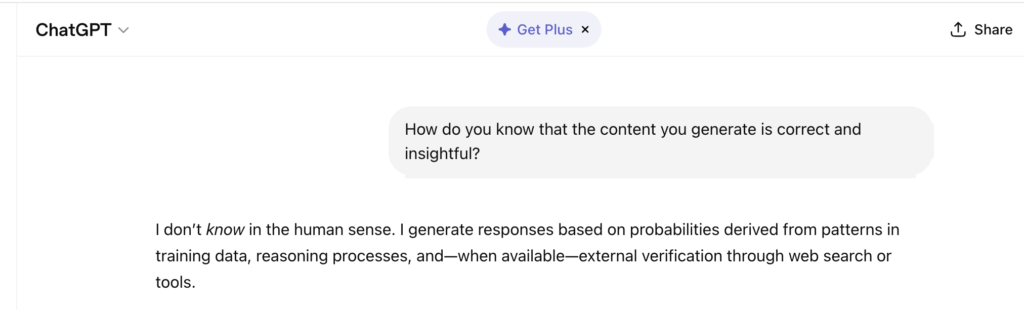
By the end of the conversation, Chat admitted the information it produces is “false depth” — language that sounds profound but collapses under scrutiny.
Dig underneath the surface and you discover that AI has no intrinsic mechanism for verifying truth against reality unless humans validate the data and reliable source retrieval is integrated.
What Chat basically told me is that some of the information AI produces is fabricated. By its own admittance, AI said: “it generates responses based on probabilities, reasoning processes and…web search.”
Sometimes, AI will produce “accurate and insightful content.”
Other times, the information will be “superficially convincing but incorrect content” and “generic observations presented as depth.”
Well, as long as it sounds believable!
But pattern recognition models simply create an apparent understanding.
When it comes to decision-making, apparent understanding can lead to overestimation.
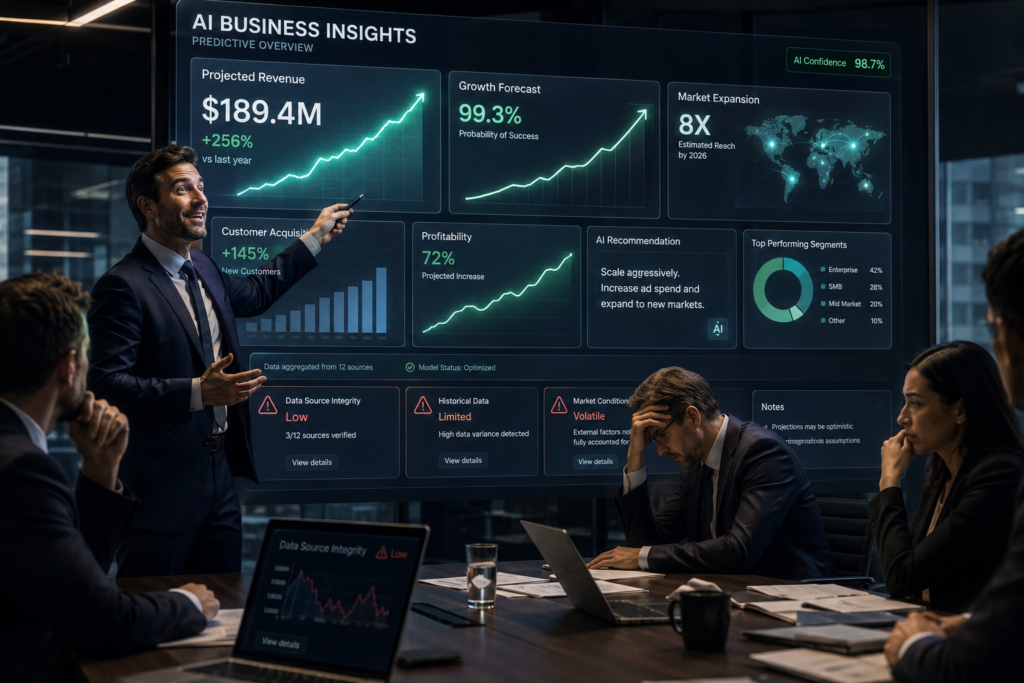
The Deception of AI-Generated Content
AI-generated content — apparently — appears to be authoritative.
In reality, they are just extraordinarily good at sounding right.
They are fluent, structured, professionally worded, and logically presented. They use the correct terminology. They hit the right beats and appear to be the product of genuine expertise.
That’s what makes AI potentially damaging.
Could organisations be making a subtle but catastrophic error?
And if so, how many will crumble once the AI foundations have eroded?
Language models are not optimised to validate information published by key industries such as medical, finance, statistics, law or science.
Your content marketing will also suffer.
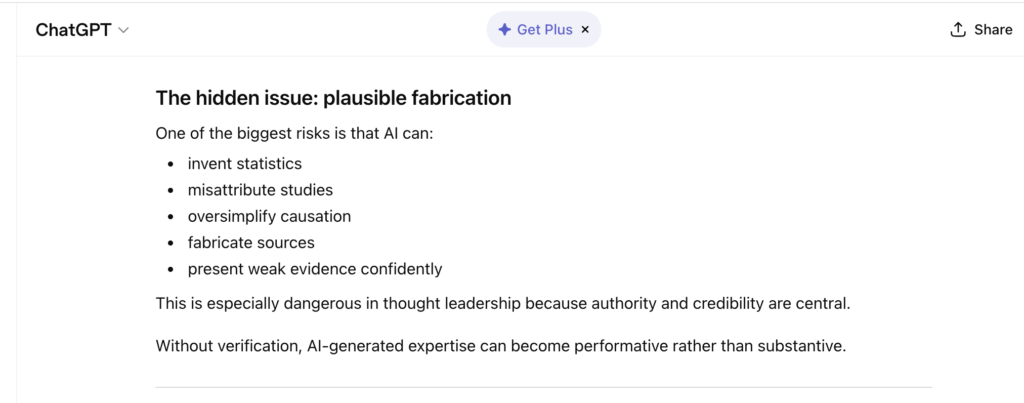
A research paper published in Nature confirms that AI tools “tend to produce false, erroneous or misleading content — commonly referred to as hallucinations.
AI’s hallucinations have a side effect I call confidence inflation — a condition where decision makers are led to believe their business capabilities are in better shape than they are, or that market opportunities are more abundant than they actually are.
When leaders are misinformed by fabricated AI-generated information because the content sounds believable, strategies can take them in the wrong direction.
The statistics and information may exist.
It is AI’s understanding and interpretation of the data that is non-existent.
An AI model can only draw on information that is made available to it. And there is a cut-off point.
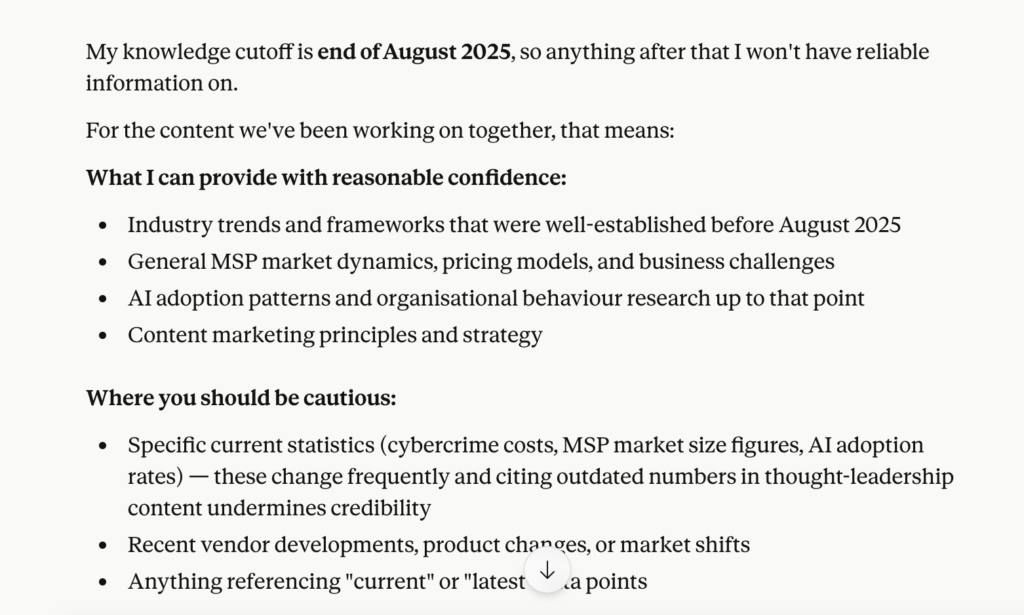
On Friday, 15th May 2026, I asked Claude when it’s cut-off date was to access statistics and data.
The reply was “end of August 2025”. Nine months ago.
If your business decisions rely on verified, up-to-date facts, forget AI.
What you get is a probabilistic estimation.
When generating content, language models are making estimates on old data and presenting suggestions that appear reliable.
They are not reliable. They are not trustworthy. And that could damage your brand reputation.
You can read the full conversation I had with AI in this article.
Pre-AI Decision-Making: It Was Better
Confidence in decision-making used to have a built-in friction mechanism.
Weaknesses, incompetence, and lack of knowledge were more obvious. Facts were harder to come by because the right questions had not been asked.
Until those questions were answered, the confidence to make key decisions was shelved.
Any seasoned professional knows that the real test of knowledge is the ability to explain complex problems and help someone else to understand the solution.
Friction may be a short-term inconvenience, but a delay is better than a disaster.
AI is systematically removing that friction.
And when you remove the mechanisms that keep the gatekeepers of knowledge honest, you develop confidence inflation among decision-makers — decisions based on cosmetic estimations that appear to have genuine credibility.

MSPs Are Watching This Happen in Real Time
If you’re running or working inside a managed services business, you’re probably seeing confidence inflation already.
You’re watching how your clients are using AI, often badly, yet with a level of confidence that should concern everyone in the room.
You see the rushed deployments.
The AI-generated IT strategies that nobody stress-tested.
An AI-produced summary of a security posture.
Most business owners are not fluent in cybersecurity terminology but feel they understand the solutions to the problems AI has given them.
Oh-oh.
You know they are dangerously unclear on what actually constitutes a threat to their specific environment.
You see the gap.
But your client is enthusiastic about AI. They are certain it’s right because the information it draws is far more in-depth than any human can even imagine.
They are wrong.
And you know they are wrong.
The clients most at risk are not the ones who are uncertain about AI. They are the ones who adopt AI tools and rely on them as critical thinking frameworks.
Let that land for a moment.
The organisations most exposed to the consequences of confidence inflation are not the late adopters sitting on the sidelines, nervously watching from a distance.
They are the enthusiastic early adopters. The businesses are enjoying an increase in output, efficiency and profits without the governance or long-term vision of the damage AI could be causing their business.
As an IT specialist, you see confidence inflation in AI-driven automation, volume outputs without the verification frameworks and confused decision-makers relying on informational access with operational wisdom.
As a content writing specialist, I see confidence inflation eroding online visibility, brand reputation and consumer trust.
The traffic statistics may look great, but what is the quality of the traffic you’re driving?
Is it high-intent traffic that converts clickers into customers?
This is what high-intent traffic looks like in SEO statistics. The blue line is the number of direct visits — returning visitors.
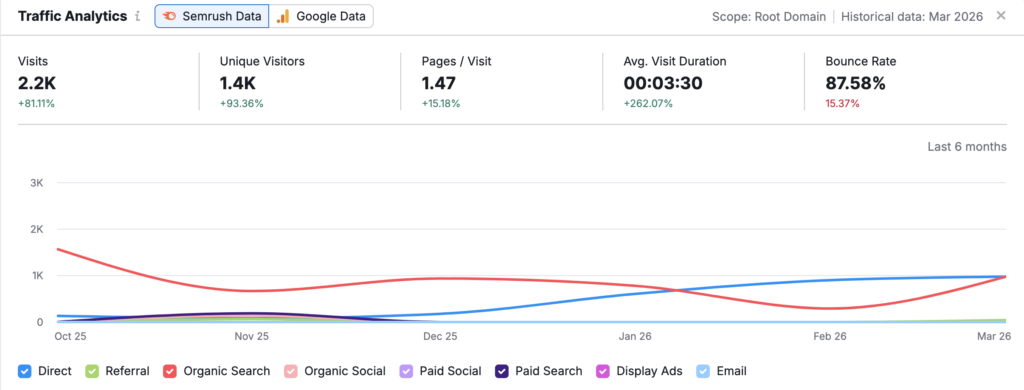
The blue line represents people who visit your website and come back to take another look.
To acquire more information.
To consider their options.
To make a purchasing decision.
The quality of your content is the difference between a visitor and a customer.
Professional Content Writing Services
AI can generate convincing content.
It cannot generate content that safeguards your credibility.
And readers are starting to recognise when content has been generated by AI content assistants.
Because it sounds the same as everyone else.
For the future of your business, write content that is genuine, accurate and credible.
And if you find it difficult to write engaging content yourself, get a professional content writer to do it for you.
No Responses