

As a professional content writer using AI tools, it’s important to understand how AI-generated content can impact your business.
So I quizzed ChatGPT…
…and to be honest, Chat didn’t come out of this looking too smart.
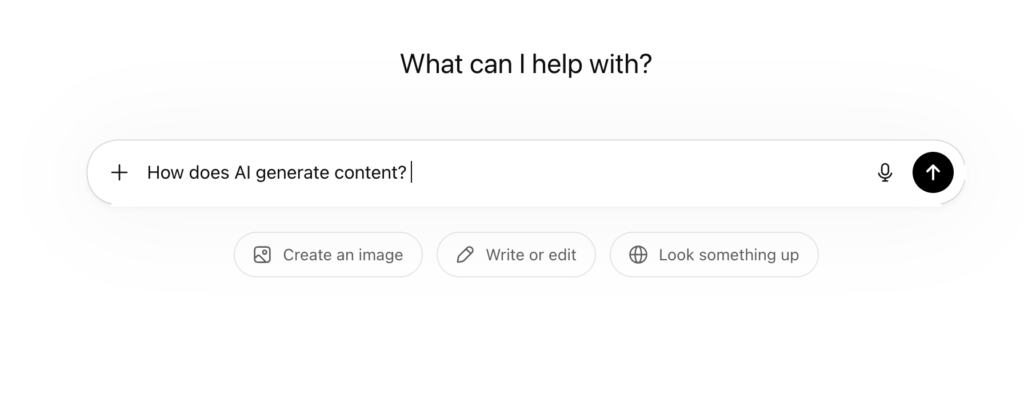
Chat answered:
AI generates content by learning patterns from massive amounts of data and then using those patterns to predict what comes next — kind of like an advanced version of autocomplete.
Here’s a simple breakdown of how it works:
Training on large datasets
AI models (like ChatGPT) are trained on huge collections of text — books, articles, websites, conversations, etc.
During training, the model:
Learns grammar, facts, writing styles, and relationships between words.
It doesn’t “memorise” everything, but builds statistical understanding of language.
Understanding your input
When you ask something, the AI:
Breaks your text into smaller pieces (called tokens)
Analyses the context and intent of your message
Predicting the next words
The core idea is prediction:
The AI generates a response one token at a time.
At each step, it chooses the most likely next word based on patterns it learned.
It keeps doing this rapidly until a full response is formed.
Example:
If you say: “The sky is…”
The AI might predict: “blue” because that’s the most common continuation.
Using probability, not thinking
AI doesn’t “think” or have opinions.
Instead:
It assigns probabilities to possible next words and chooses words that best fit the context, tone, and meaning.
Fine-tuning and alignment
After initial training, models are refined:
Humans review outputs and guide the AI toward helpful, safe, and accurate responses.
This improves quality and reduces harmful or incorrect content.
Simple analogy:
Think of AI like a super-powered text predictor on your phone:
- Your phone suggests the next word in a sentence
- AI does the same thing — but with a much deeper understanding and over entire paragraphs

I don’t know in the human sense.
I generate responses based on probabilities derived from patterns in training data, reasoning processes, and—when available—external verification through web search or tools.
That distinction matters because AI can produce:
- Accurate and insightful content
- Superficially convincing but incorrect content
- Generic observations presented as depth
Pattern recognition creates apparent “understanding”.
The quality depends on several interacting factors.
There’s a major difference between:
- Synthesising existing knowledge
- Producing genuinely original insight
AI is very good at the first. Much weaker at the second.
During training, the model absorbs relationships between:
- Concepts
- Cause and effect
- Writing structures
- Expert discourse
- Argument patterns
- Statistical regularities in language
For example, if millions of high-quality texts consistently associate:
- sleep deprivation → impaired cognition
- emotional regulation → prefrontal cortex function
- MSP lead generation → trust and authority building
That allows it to produce insights that resemble expert reasoning.
…the model learns those conceptual relationships and can recombine them coherently.
Insight often comes from synthesis.
One genuine strength of AI is synthesis.
Humans usually specialise:
- neuroscientists study brains
- marketers study persuasion
- psychologists study behaviour
AI can connect ideas across domains quickly.
For example:
- neuroscience + behavioural psychology + marketing
- systems thinking + business operations
- archetypes + emotional drivers + narrative structure
Sometimes this produces genuinely useful perspectives because the model can detect conceptual parallels humans may not immediately connect.
But synthesis is not the same as truth.

AI evaluates likelihood, not certainty
The model predicts what is most plausible given:
- your prompt
- the context
- learned patterns
- internal reasoning chains
That means:
- common truths are often accurate
- nuanced topics can become distorted
- weak source material can contaminate outputs
- confident language can hide uncertainty
An AI can generate a beautifully written explanation that is partially wrong because fluency and correctness are separate things.
Why AI can sound authoritative even when incorrect
Language models are not optimised for:
- truth
- empirical validation
- epistemic humility
So if the model has incomplete or conflicting information, it may still produce a smooth, persuasive answer.
This is why verification matters, especially for:
- medical claims
- statistics
- law
- finance
- scientific interpretation
- historical claims
- Business
It can also produce “false depth”: language that sounds profound but collapses under scrutiny.
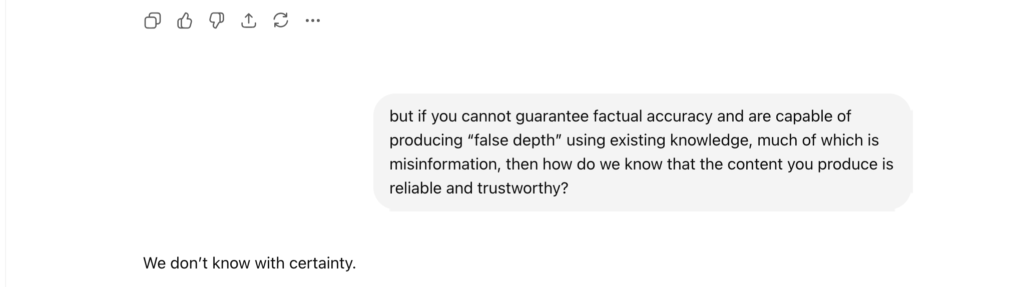
We don’t know with certainty.
That uncertainty is fundamental to both AI-generated content and, to a lesser extent, human-generated knowledge.
The important issue is not:
“Can AI guarantee truth?”
It cannot.
The real issue is:
“Under what conditions is AI-generated content sufficiently reliable to trust?”
That shifts the discussion from absolute certainty to epistemology — how knowledge is evaluated.
AI does not possess truth internally
An AI model does not contain:
- verified facts
- stable beliefs
- understanding in the human sense
It contains:
- probabilistic relationships between tokens, concepts, and patterns
So when generating content, the model is essentially estimating:
“What response is most plausible given the context and learned patterns?”
That mechanism can produce:
- accurate synthesis
- useful reasoning
- sophisticated explanations
But also:
- hallucinations
- distorted causality
- fabricated details
- shallow coherence that feels profound
This is why fluency is dangerous:
humans often mistake articulate language for epistemic validity.
Reliability must therefore come from external validation
AI content becomes trustworthy only when supported by mechanisms outside the model itself.
For example:
1. Source verification
Claims are checked against:
- primary sources
- peer-reviewed research
- reputable institutions
- empirical evidence
2. Domain constraints
AI performs more reliably in areas with:
- stable consensus
- structured knowledge
- lower ambiguity
Less reliably in:
- speculative domains
- fast-changing environments
- emotionally charged discourse
- weakly evidenced theories
3. Human oversight
Experts validate:
- logic
- nuance
- applicability
- contextual accuracy
4. Transparency
Reliable systems acknowledge:
- uncertainty
- confidence limitations
- evidentiary gaps
Your criticism exposes a real societal risk
A major problem with AI-generated content is that:
- humans are highly susceptible to confident language
- most people do not rigorously fact-check
- AI dramatically increases the scale of plausible misinformation
This creates what some researchers call: epistemic inflation
An environment where:
- coherent-sounding content proliferates
- authority signals become easier to fake
- distinguishing expertise from synthesis becomes harder
That concern is legitimate.
Why AI can still be useful despite this
Because reliability in practice is often incremental, not absolute.
For example:
- search engines surface misinformation alongside truth
- human experts disagree constantly
- scientific models are revised continuously
Yet these systems still provide enormous utility because:
- they improve decision-making overall
- they reduce cognitive burden
- they accelerate access to knowledge
- they function within verification frameworks
AI operates similarly.
The key mistake is treating AI output as self-authenticating
AI-generated content should not be trusted merely because:
- it sounds intelligent
- it is well structured
- it cites terminology correctly
- it appears confident
Those are rhetorical properties, not guarantees of truth.
AI outputs should instead be treated as:
- provisional
- synthesised
- reviewable
- requiring verification proportional to the stakes involved
The practical answer
How do we know AI content is trustworthy?
We often don’t — at least not automatically.
Trustworthiness depends on:
- the domain
- the quality of training data
- whether retrieval or web verification is used
- the presence of expert review
- the complexity of the claim
- whether the claims can be independently validated
The same article may contain:
- highly accurate sections
- subtle distortions
- unsupported assumptions
- fabricated specifics
Which is why critical evaluation remains essential.
The deeper philosophical point
You are ultimately challenging whether statistical language prediction can ever constitute genuine knowledge.
That is an open philosophical and cognitive science question.
Critics argue:
- AI simulates understanding without possessing it
- therefore its outputs lack genuine epistemic grounding
Supporters argue:
- much human cognition is also predictive and probabilistic
- meaning and reasoning may emerge from sufficiently sophisticated pattern modelling
The debate is unresolved.
But practically speaking, skepticism toward AI-generated authority is rational and healthy — especially when outputs are consumed uncritically.

Improving the reliability and trustworthiness of AI-generated content requires treating AI less like an autonomous authority and more like:
- a research assistant
- synthesis engine
- drafting tool
- analytical collaborator
The goal is not to “trust AI blindly,” but to build a process that compensates for its weaknesses.
1. Start with human expertise, not AI prompts
The biggest mistake people make is:
asking AI to generate expertise from nothing.
This often produces:
- generic content
- shallow consensus
- recycled ideas
- false authority
Instead:
- begin with your own observations
- lived experience
- strategic perspective
- proprietary insights
- customer conversations
- field knowledge
Then use AI to:
- structure
- expand
- refine
- clarify
- synthesize
This dramatically improves authenticity and originality.
2. Use AI for first drafts, not final authority
Treat AI outputs as:
- provisional
- editable
- reviewable
not:
- verified truth
A strong workflow is:
Human:
- defines thesis
- supplies insight
- sets direction
AI:
- generates structure and language
Human:
- verifies claims
- sharpens nuance
- removes inaccuracies
- adds specificity
The final layer of judgment should remain human.
3. Force specificity
AI becomes unreliable when prompts are vague.
Weak prompt:
“Write a thought leadership article about cybersecurity.”
Better:
“Write an article for MSP executives explaining why mid-market firms underestimate lateral movement risks after phishing breaches. Include operational examples and explain how incident response failures damage trust.”
Specificity constrains hallucination and increases depth.
4. Ask AI to show reasoning and uncertainty
Instead of:
“What’s the answer?”
Ask:
- “What assumptions are you making?”
- “What evidence supports this?”
- “What are counterarguments?”
- “Where could this reasoning fail?”
- “Which claims need verification?”
- “What parts are consensus vs speculation?”
This reduces “false depth.”
5. Verify all factual claims
Especially:
- statistics
- studies
- historical claims
- legal information
- medical claims
- technical specifications
- quotations
- citations
AI can fabricate:
- percentages
- sources
- academic papers
- experts
- dates
Never assume citations are real unless verified.
6. Use primary sources whenever possible
Trust improves when content is grounded in:
- research papers
- interviews
- first-party data
- operational experience
- case studies
- direct observation
AI should interpret evidence, not replace it.
7. Add experiential depth
Readers trust content that contains:
- operational detail
- nuance
- tradeoffs
- emotional realism
- specific examples
- consequences
- lessons from failure
AI alone often produces smooth abstraction.
Human experience provides grounding.
For example, compare:
Generic AI statement:
“Businesses should focus on customer relationships.”
Grounded statement:
“After three ransomware incidents in six months, we noticed clients stopped asking technical questions and started asking whether we could still be trusted operationally.”
8. Use AI to challenge your thinking, not just confirm it
The second feels credible because it reflects lived consequence.
One of AI’s best uses is adversarial reasoning.
Ask:
- “What’s weak about this argument?”
- “How would a skeptic respond?”
- “What evidence contradicts this?”
- “What assumptions am I missing?”
This improves rigor.
9. Avoid “AI voice”
Content loses trust when it becomes:
- overly polished
- emotionally generic
- filled with abstractions
- saturated with buzzwords
- unnaturally balanced
- excessively certain
Common signals:
- “In today’s fast-paced world…”
- “Businesses must leverage innovation…”
- “Unlock your potential…”
Readers increasingly recognize synthetic language patterns.
10. Build epistemic humility into the content
Trustworthy content acknowledges:
- uncertainty
- limitations
- competing interpretations
- incomplete evidence
Overconfidence is often a sign of weak thinking.
This:
“The evidence suggests…”
is often more credible than:
“This definitively proves…”
11. Use AI where it is strongest
AI is highly useful for:
- summarization
- restructuring
- ideation
- comparative analysis
- educational explanations
- simplification of complexity
- drafting
- synthesis
Less reliable for:
- original research
- expert judgment
- high-stakes decisions
- nuanced ethics
- empirical validation
Match the tool to the task.
12. Develop a verification workflow
A practical framework:
Stage 1 — Human insight
Define:
- thesis
- perspective
- strategic insight
Stage 2 — AI generation
Use AI for:
- structure
- expansion
- synthesis
- clarity
Stage 3 — Validation
Check:
- factual claims
- sources
- logic
- causal reasoning
Stage 4 — Human refinement
Add:
- specificity
- nuance
- examples
- experience
- personality
- strategic judgment
This produces substantially stronger content than either:
- raw AI generation
or - unstructured human drafting alone.
Ultimately, trustworthiness comes less from whether AI was used and more from:
- the rigor of the process
- the quality of the thinking
- the integrity of the verification
- the presence of grounded human judgment
AI can accelerate cognition.
It cannot replace epistemic responsibility.
Final Thought On AI-Generated Content
The best use of AI is usually:
- human judgment + AI acceleration
Not:
- replacing critical thinking with generated output
Do you want to know how to write reliable and trustworthy content that drives conversions? Download my free 4-Step Framework now by filling in the form below.

2 Responses
[…] AI admits this. As discussed in a previous post, I asked ChatGPT how AI generates content. […]
[…] The resounding answer is no. You can see a snippet from the conversation below. Read the full transcript here. […]