

MSP owners and executives are in a quandary when choosing between AI tools and the cost of content writing services.
Sure, your content strategy is working wonders for SEO.
But none of the traffic is converting.
Without a steady stream of hot leads flowing through your pipeline, enquiries and clients begin to dry up.
Outbound efforts are increasingly ignored.
Referrals are unpredictable.
Buyers are conducting more independent research before ever speaking to a provider.
So what’s going wrong?
What do you know about content marketing?
Content marketing is a critical growth lever.
You know that.
It allows you to shape perception, demonstrate expertise, and build trust at scale — long before a sales conversation begins.
You know that too.
But content writing services come at a cost — and you don’t know if you can justify an expense that can be avoided by using an AI assistant.
AI is free.
We have a clear winner.
Yet the temptation to rely on AI tools to deliver effective content writing quickly and cheaply comes at a cost!
AI-generated content may be efficient, but is it effective?
Perhaps this is what you don’t know about content marketing!

The Strategic Role of Content Writing Services
Before addressing the limitations of AI, it’s important to understand what a content writing service is supposed to do for an IT support business.
Effective content is not filler.
It is not there to “keep your website active” or satisfy an algorithm.
Blog content writing plays a key role in:
- Translating how IT services provide business value
- Position your firm as a trusted authority
- Develop trust by providing insights, solutions and information
- Address buyer concerns at each stage of the decision-making process
- Reduce perceived risk for decision-makers
- Showcase who you are behind the screens — your brand personality should have a voice people want to read
But content writing services are much more than blog writing.
Its strategic role is to inform, educate and inspire prospects across multiple platforms. MSPs are in an advantageous position to reach out to business owners and tell them what they need to know.
So then, do that.
The IT landscape is complex and often misunderstood by the average business owner.
Buyers don’t naturally grasp the implications of poor cybersecurity, outdated infrastructure, or reactive IT models.
Your content must bridge that gap by describing the outcome and benefits.
Yet most MSPs are writing bland content about services and events. Fine. These things are worthy of a mention to let people know who you are and what you, but when they dominate your entire feed, nobody is bothered.
Do you know what they are bothered about?
Themselves.
They have problems they need to solve. You could tell them, but all they can find on your blog and social media account is news of a networking event you attended.

AI-generated content is not much better.
Okay, there is an article there, but the content is so generic it doesn’t solve anything.
That’s because is pulling content from similar sources — from other MSP websites you’re rivalling in search engine requests.
And herein lies the problem.
Google has always and will always reward websites that consistently publish high-quality and trustworthy content that offers value.
Since the Panda update, circa 2011, Google has started penalising low-quality, generic and duplicate content.
And Google will continue to penalise low-quality, generic and duplicate content.
The 2024 ‘Helpful Content Update’ demonstrated Google’s intention to target “cheap” and “hacked” content that doesn’t offer value.
The Problem with AI-Generated Content
AI can produce content quickly, but speed is not the constraint that limits growth for IT support firms.
The real constraint is quality.
AI-generated content tends to suffer from several structural issues.
1. AI Lacks Strategic Intent
AI generates text based on patterns.
Whilst it appears to generate coherent, technically accurate content for Managed Service Providers (MSPs), the fundamental need for strategy is lacking.
Even the best AI writing assistants do not understand your commercial objectives, your ideal client profile, or your positioning in the market — unless you tell them.
Used aimlessly, AI content will:
- Speak to a broad, undefined audience
- Miss the nuances of buyer intent
- Fail to guide the reader toward a meaningful next step
For an IT support firm, this is a critical flaw.
Content writing services designed for MSPs is not just about producing content for the sake of filling out your blog and social media accounts.
An effective content strategy positions your messaging with specific business objectives of your target audience. The result is long-term client value.
Strategy is what good content writing services excel at. A long-term vision delivers consistent rewards and longevity.

2. AI Produces Surface-Level Insights
AI is inherently derivative. It synthesises existing information but rarely produces original thinking or insights you can describe as thought leadership.
What you will get is content that:
- Repeats widely known facts and ideas
- Avoids taking a clear stance
- Fails to challenge the reader’s assumptions
In the competitive pool MSPs swim in, surface-level insights are not helpful.
The majority of your audience already know what the issues are for them. They don’t want to know their problems, they want someone who understand their problem and knows how to fix it.
If your content is addressing the same problems and offering the same advice as everybody else, how will you stand out?
The chances are you won’t.
And if you’re not already ranking in search engines, it’s unlikely you ever will.
AI content might be free, but the existing models could cost you your business.
What’s your return on investment?
In contrast, content writing services are designed to drive conversions. Although the initial upfront payments may appear to cost more, the results a content strategy will deliver end up paying from themselves.
In that regard, content writing services are much the same as managed IT support services. You don’t recognise the value until you try it.
Now you know how your potential clients feel.
The only difference is that for MSPs, even a single conversion a month would mean you recover your return on investment.

3. AI Struggles to Understand Purchasing Decisions
One of the biggest challenges for MSPs devising a content marketing strategy is translating technical detail into business relevance — and hitting the right mark with the right people.
AI cannot truly reinterpret your IT expertise through the lens of a specific buyer’s reality. It can provide content, but it can’t provide context.
Instead, it defaults to:
- Overly technical explanations that alienate non-technical decision-makers
- Or overly simplified content that lacks credibility amongst technicians
The balance required to communicate complex ideas in a way that resonates with executives is often missing.
And this disconnect creates confusion rather than clarity. Confused prospects do not convert.
MSPs fare better with a content writing service which is able to translate technical capability (e.g. “endpoint detection and response”) and reframe it into outcomes.
For example, rather than a title that reads 10 ways to Prevent Downtime go with “How we stop downtime that costs you £10k per hour”).
Titles should echo the buyer’s priorities, search intent, and decision-making triggers.
To do that, you have to know who your audience is and mould a piece of content that answers their questions.
Because AI operates on statistical associations, rather than lived context, it doesn’t inherently know whether it’s speaking to a risk-averse finance director, an operations manager under SLA pressure, or a non-technical business owner who only cares about continuity.
Even with clear prompts, AI assistants can be slapdash with the content because it pulls content from similar topics but without fully understanding the nuance.
The core issue is semantic mapping — a technique that organises information around topics.
Effective marketing content maps service features → business outcomes → emotional drivers → buying action.
AI can handle the first step (features), occasionally the second (outcomes), but it rarely captures the third and fourth with precision because those depend on human experience.
4. AI Content Cannot Build Genuine Trust
Whilst AI can support content production, it struggles to build genuine trust in a way that content writing services can.
For MSPs, credibility carries a lot of weight in a saturated market.
First, trust is grounded in real-world experience.
Business owners looking to invest in IT support want reassurances that you can save money and help to improve revenue.
They not only want to know that you understand the causes and consequences of downtime, security incidents and user frustration, they want to know the outcomes and benefits.
AI can’t relate to these pressures with any emotional connection because it has never felt them.
And content marketing involves tapping into the emotions of decision-makers. Let them know you feel their pain.
Executives may not consciously identify the flaws that are holding their business back, but they feel them.
That connection, that understanding of the pain they are experiencing, has a significant sway over whether they trust your brand.
But trust is not built through information alone.
It is built by developing a relationship.
You develop a relationship by saying the right things at the right time. You do that by aligning content with search intent.
Authority and expertise build trust.
Another thing: trust depends on clear positioning and a strong opinion.

MSPs should be producing content about systems, software and strategies you recommend. Likewise, tell people what to avoid and why.
If you consider the majority of content published on the internet is promotional (disclaimer: I don’t have stats or evidence other than my eyes to verify this claim), AI will lean towards popular consensus.
Think about that for a moment.
What message are you sending out by regurgitating the opinion of others?
“Nothing to report here!” That’s what.
A third pillar of trust used by content writing services is built through consistency of voice and intent.
Prospects engage when they recognise a distinct point of view across your website, emails, and sales conversations.
AI-generated outputs can be coherent, but they don’t originate from a single, accountable perspective.
Without continuity, content feels disjointed, and your messaging gets lost because it isn’t targeting the right audience.
Content that does not get the message across does not earn trust.
In short, trust comes from insight, experience and conviction — signals that resonate with your audience at the right times.
5. AI Invites Reputational Risk
There’s no doubt that AI writing assistants can produce content that appears credible on the surface. To an untrained IT professional, AI might even be persuasive.
Over time, that could pose a problem for MSPs executives who claim one thing but deliver another.
AI does not lie, but that does not mean it gets everything correct. Some artificial assistants openly admit their machines make mistakes:

In a domain where trust is built on expertise and accuracy, even subtle errors in specialist areas like cybersecurity, compliance, or infrastructure can be remembered by clients who only know a handful of “facts”.
Some statements stick in people’s minds. If you make a statement that turns out to be untrue, it could signal incompetence by a disgruntled client looking for somebody to blame.
Your brand image and the reputation you build with your audience could be undone in a single sentence.
How Content Writing Services Eliminate Costs
Professional content writing services do not simply produce higher-quality content than AI.
Experienced writers operate on a different level altogether.
An effective content writing service includes an entire strategy which combines:
- Audience insight
- Buyer intent
- Targeted messaging
- Multiple platforms
- Brand personality
1. Strategic Funnels
Content only becomes commercially effective when it intentionally guides prospects from initial awareness through to decision.
The key is meeting your prospects where they are — which search engines organise for you.
Strategic funnels involve designing content around buyer intent.
A professional content writing service knows that pieces sitting at the top of the funnel are traffic chasers and attention seekers.
The articles at the awareness stage are predominantly designed to identify the real problems your ideal clients are actively trying to solve; i.e. downtime risk, compliance exposure, cost unpredictability etc.
Top of funnel content speaks directly to those pressures. This ensures you not only cast your net far and wide, but you also capture an audience with search intent.
This strategy has become even more important for MSPs, given AI search surfaces are dominating attention.
Google says AI search determines “browse intention”. In other words, search engine algorithms collect data from the browser history to determine what answers the search is looking for.
Essentially, Google is trying to understand search intent by analysing search terms during the discovery phase.
In the middle of the funnel, strategy becomes more precise.
Content writing services anticipate objections, knowledge gaps, and solutions that your preferred ideal customers experience.
At this stage, you want your audience to say, ‘these guys understand my problem!’
Content here is designed to build trust and reduce friction — case-led insights, comparison pieces, and problem–solution narratives that help prospects justify change internally.
At the bottom of the funnel, messaging is aligned with buyer intent.
MSPs should be looking to produce content that clearly articulates how managed IT support services lower risks and costs. Talk about tangible outcomes.
What you must understand is that decision-makers are not just evaluating services; they’re assessing credibility, reliability, and fit.
They are looking for a partner.
Therefore, brand personality matters.
A content strategy is not simply about the information you provide — it’s about how you deliver that information. That is a skill content writers develop, which, in my opinion, AI hasn’t nailed yet.

2. Depth of Insight and Original Thinking
Engaging content has depth and originality.
A seasoned content writing service produces thought leadership content that addresses issues few people can even see. The capacity to be a visionary gives your content long-term legs.
By its own admission, AI models can’t predict the future because they only have the capacity to recycle existing narratives.
Chat did say: “ It can model probabilities based on historical data, identify trends, and run forecasts — but all of that is constrained by what has already happened and the assumptions built into the model.”
To be a visionary, you need to have an imagination and connect the dots that you see emerging in the real world.
A skilled writer interrogates the business world, identifies developments across several key industries at the forefront of tech and visualises how the business landscape will develop over time.
Thought leadership content puts MSPs at the forefront.
Depth of insight comes from domain immersion and pattern recognition grounded in experience. A professional writer understands recurring client objections, decision-making dynamics, and industry-specific risks.
Being able to connect technical capabilities to commercial outcomes enables a content writer to address issues decision-makers want to know about — or at the very least, to raise curiosity so they follow you on socials.
Original thinking introduces contrarian perspectives and reframes familiar problems to create clarity and authority. This is what elevates content from informative to influential.
The result is content that is distinctive, credible, and aligned with business objectives— positioning your IT support company as a trusted authority rather than just another voice parroting popular opinion.
3. Precise Audience Targeting
Strategic content writing services are built around a granular understanding of the audience — and not broad assumptions.
RJO Content takes a deep dive into your ideal preferred client (your PIC) and develops a client persona. Personas (or archetypes) have personality and emotional patterns you can draw on to engage, move and inspire.
Audience targeting goes beyond identifying surface-level problems; it involves mapping how problems create specific pain points.
MSPs have solutions for all types of specific pain points. Talk about the ones your PIC is experiencing.
Equally important is insight into the decision-making process. In most organisations, buying decisions are rarely linear. Discussions take place outside the boardroom and across departments.
How connected is your social network within any one company?
A content writing strategy has more than one audience member, even if they work at the same company. Essentially, your audience is not the business per se — it’s the people who represent the business.
A professional writer considers the full buying unit — who initiates the conversation, who influences it, who signs it off.
Create content that supports each stage of the problem, pain point and solution.
A typical buying journey follows the ADDD path:
Awareness.
Discovery.
Discussion.
Decision.
4. Brand Personality
Your content reflects who your people are as a business and how your business thinks.
The real skill of a talented content writer is developing a brand personality which earns trust.
Professional content writing services don’t just standardise tone; we engineer a voice that is original, engaging and entertaining.
Crucially, originality introduces entertainment value — which matters more than most B2B brands dare to admit. Whilst most brands want to come across as professional, it’s smart to remember that decision-makers are human; they engage with content that holds their attention.
When your content is both strategically consistent and inherently interesting to read, it doesn’t just communicate — it differentiates, resonates, and endures.
Developing a brand personality means moving beyond safe, generic “corporate” language — which, quite frankly, is stale and often pretentious.
Good writing speaks to the reader as though you are talking to them in the same room.
Have a bit of fun…
…because writing with personality gives you an edge over competitors!
Think about this.
Which brand do you want to read?
A: Content written by either AI or an in-house technician — generic and woefully lacking personality.
B: Content written by a skilled writer that can develop an entertaining brand personality.
FYI: I did try teaching my AI to have personality, but it comes across as cheesy and, dare I say, like an American Mr Motivator.
One for the kids there.
With a brand personality, your audience begins to associate your content as a go-to source with perspective, insights and solutions. Throw in a handful of provocative sentences, and you have the ingredients for conversion cake.
Would you like cream or chocolate drizzle with that?

5. Expand Online Presence
A content marketing strategy should not involve “publishing more content” — it should focus on expanding your online presence.
A deliberate expansion strategy is designed to increase visibility, authority, and memorability.
According to psychology, the typical consumer needs to see a brand pop up between five to seven times before they remember it, and between seven and 20 touchpoints before they actively inquire or make a purchase.
The fundamental idea behind this stat is that repetition builds familiarity and trust with the brand.
Expanding online presence involves an on-page and off-page assault across the internet. Socials are a given. LinkedIn at the very least. There are also platform like Substack, Medium and Reddit that appear high in search engines.
You can publish the same piece of content on your blog as you post on Medium. Both articles should show up in the same search intent, but, until you establish authority, the article on Medium will be the page that gets the eyeballs.
On the topic of making an appearance in search engines, AI content will probably damage your search rank.
We know that Google has a longstanding intolerance for “filler” content — pages that are thin, unhelpful or fail to offer value.
Algorithm changes like the Google Helpful Content Update were explicitly designed to devalue generic, surface-level content that exists purely to rank.
On the flip side, the search engine behemoth rewards “helpful, reliable, person-first” content.
In other words, if your content reads like it was written to please an algorithm rather than help a human, it’s likely to underperform — and disappear altogether.
A dedicated content writing service plans for SEO.
Instead of churning out keyword-stuffed blogs, we create topical depth —clusters of content that demonstrate expertise, answer nuanced questions, and keep users engaged.
For example, we create a pillar post like the one you are reading right now, and then build content around it that addresses the points raised: why AI can be costing your business and why a content writing service will see an ROI.
Each piece strengthens the overall domain authority.
And here’s the blunt truth: the internet doesn’t need more content — it needs better content.
I know you just agreed with a slight face shift and a ‘mmm’.
Everyone knows the internet needs better content, but most people are still churning out dull, repetitive content written by AI.
You could be different.

The Cost of AI
The reality is that AI will cost your business more because, without strategy and audience alignment, it produces content that generates traffic but fails to convert it into qualified leads or revenue.
AI writing assistants may be free to use, but they won’t generate revenue through a content marketing strategy either. You still need to pay an employee, or a contractor to produce content.
So you may as well employ a good writer.
The Cost of Content Writing Services
To cut to the crux: content writing services result in conversions. It pays for itself.
That said, it’s smart to manage expectations. Results are rarely immediate. Unless you already have a reasonable content strategy in place to build on, developing your online profile will take several months to accomplish.
For example, search visibility, authority, and trust compound over time — not overnight. Thus, content marketing services typically take several months to bear fruit — again depending on your current set-up.
Early indicators tend to be improved engagement, longer dwell time, and a gradual increase in traffic.
This is how you will know the strategy is working.
Take a look at the image below and pay particular attention to blue line which comes out of nowhere but hits 1K in Mar 26.
That blue line measures direct traffic. Direct traffic is an indicator of return visits.
Returning visitors are high-quality leads.
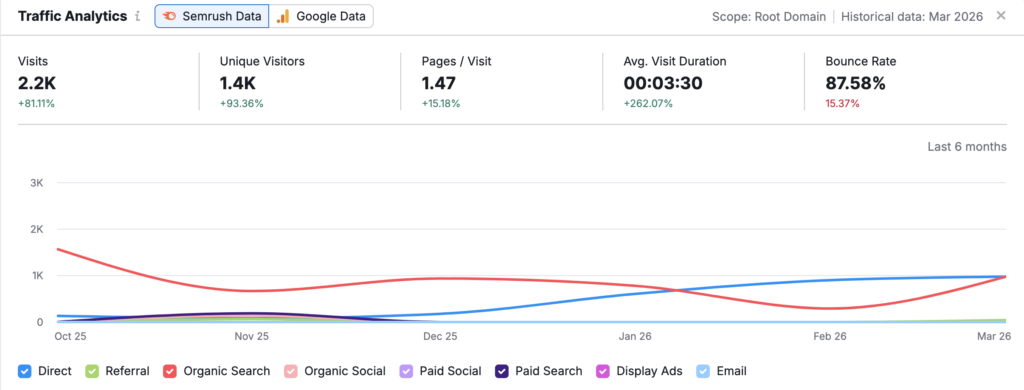
Please bear in mind that I only started writing for this client in October 2025. Previously, they had been publishing AI-generated content.
Their bounce rate is in the 80s. That’s people leaving.
Now look at the increase in avg. visit duration, or dwell time. Up by 262%. Visitors are staying to read the content.
Now look at unique visitors versus total visitors, a difference of 800K. Those 800,000 visitors are coming back for more.
When executed properly, effective content marketing services become a cost-efficient channel for client acquisition.
Moreover, it reduces reliance on paid ads and continues to generate leads long after publication.
In the UK, a content writer or content marketing service typically ranges from £800 to £3,000+ per month, depending on scope, expertise — and overheads.
Because I work from home and do not have overheads, I pass the savings on to my clients.
This is reflected in the competitive pricing. The RJO Content Starter Pack is £750, and for that, you get a healthy amount of content plus online management.
My Premium package at £1900 per month gives you the most value for money and gets results quicker. The cost is significantly lower than that of other marketing agencies offering content writing services who are saddled with overheads.
You can see the packages we offer and what you get for your investment on the packages page.
At the lower end, most content writing services provide a set number of blog articles, strategy, keyword research, SEO optimisation, and performance tracking.
RJO Content gives you all that but also provides upgrades to your website, landing pages, social media content, online management, an outreach strategy, funnel planning, audience targeting, and thought leadership content.
Changed Your Mind About AI & Content Writing Services?
There no doubt that AI has a role in modern marketing workflows.
But it is not a substitute for strategic thinking or human insight.
For IT support firms operating in a competitive, trust-driven market, relying on AI alone offers short-term efficiency but long-term damage.
Content writing services drive conversions by publishing entertaining content that offers clarity, solutions and influence.
The difference is significant: one produces content, the other builds an asset.
Over time, that asset compounds — turning consistent, strategically aligned output into measurable pipeline and, ultimately, revenue.
And in a market where buyers are increasingly informed and selective, those qualities are not optional — they are decisive.
Want to know more about our content writing services?
Check out another one of our pillar posts and learn how our content writing service is designed to generate more conversions for MSPs.
Or jump straight in by downloading our 4-step framework for creating content that drives conversions. Simply fill in the form below and we’ll get back to you asap.

5 Responses
[…] As a content creator using AI tools, it’s important to understand how AI-generated content can impact your business. […]
[…] Don’t rely on AI to generate content. If you do, it could prove costly to your business. […]
[…] use AI to write your content. Use it for ideas. Otherwise, AI will damage your brand reputation. And that could prove costly for […]
[…] I address this issue in-depth in an article discussing the real cost of AI. […]
[…] AI is, and will silently cripple your business. […]