One month you’re turning work away.
The next, you’re refreshing your inbox every ten minutes and wondering whether the phone has stopped working.
Sound familiar?
What’s happening with your content marketing?
Let’s get into it.

The Feast and Famine Cycle Is a Symptom, Not the Problem
Most small business owners experience the same pattern.
Things get busy — you’re delivering work, managing clients, keeping plates spinning — and marketing quietly falls off the to-do list.
Then the work dries up, panic sets in, and you scramble back into action: posting on LinkedIn, chasing referrals, maybe updating the website at 11pm with a glass of wine and a growing sense of existential dread.
The frantic activity produces a few leads. You land some work. Things get busy again. Content marketing falls off the list again.
And the cycle repeats.
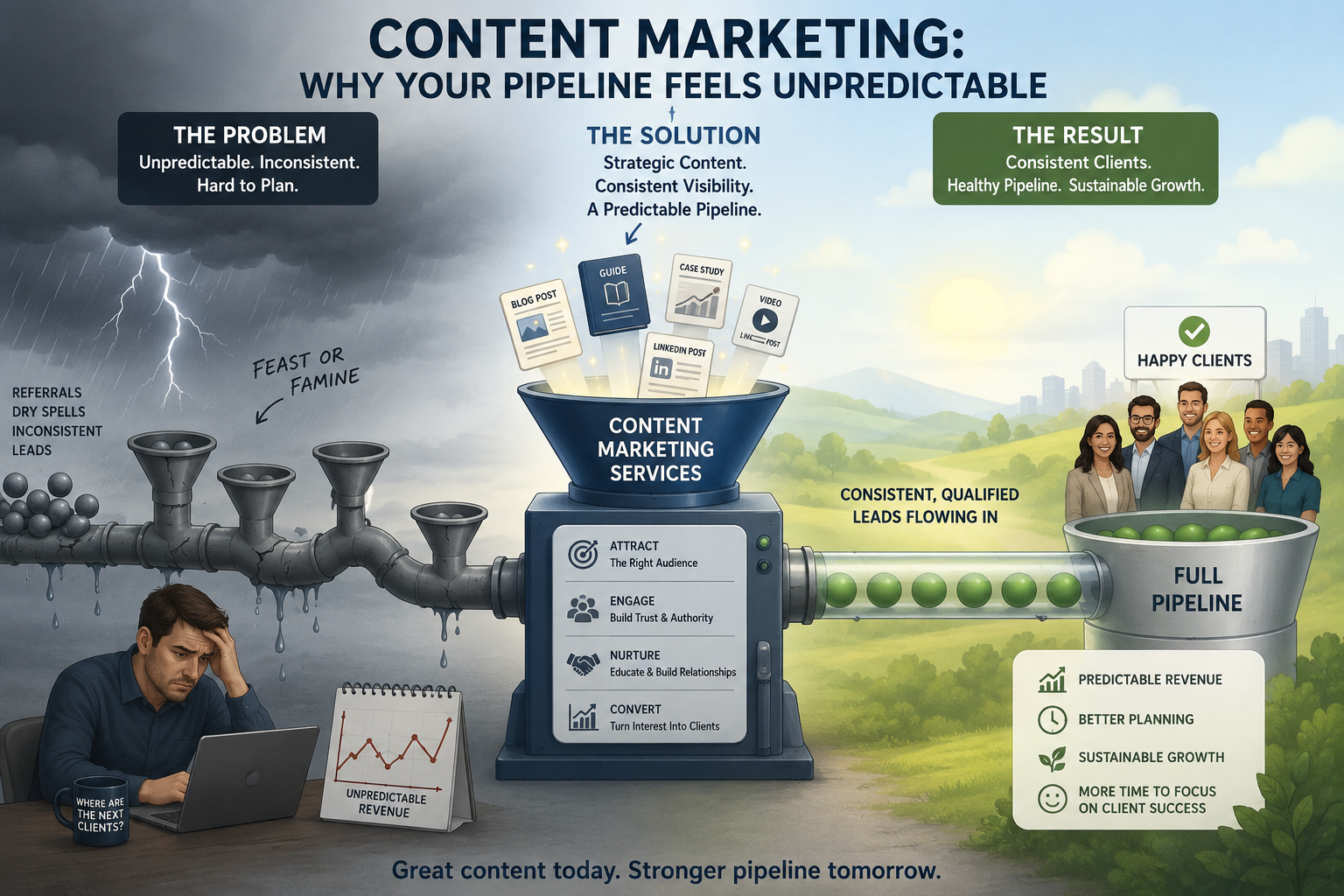
The feast and famine cycle exists because your pipeline is entirely dependent on active effort — effort that stops the moment you get busy.
What you’re missing is a system that generates leads whether you’re working on it or not.
Referrals Are Wonderful — But They’re Not a Strategy
If you asked most small business owners where their best clients come from, the answer would be referrals.
Word of mouth.
Someone knowing someone.
And referrals are genuinely brilliant — they arrive warm, pre-qualified, and usually already predisposed to trust you.
The problem is that referrals are passive. You cannot control the timing, the volume, or the quality.
You cannot decide to have more referrals next month the way you can decide to publish more content or run a campaign.
Relying on referrals as your primary source of new business is like relying on the weather for your water supply. It works — until it doesn’t.
Referrals should be the bonus, not the backbone. When you have a consistent, active pipeline strategy running in the background, every referral that arrives is a delightful surprise rather than a lifeline you’re desperately clinging to.

The Real Culprit: No Consistent Visibility
Here’s the uncomfortable truth most business owners don’t want to sit with: the people who could become your best clients don’t know you exist — or if they’ve heard of you, they haven’t seen enough of you to trust you yet.
Visibility is not vanity. It is infrastructure.
When a decision-maker — a managing director, a business owner, a head of department — is ready to buy the thing you sell, they don’t put out a tender and wait.
They think of who they already know, who they’ve seen recently, and who has demonstrated that they understand the problem.
If you haven’t been consistently visible in the places those people spend their attention, you’re invisible at the exact moment it matters most.
Most small businesses show up in bursts. A flurry of posts when things are quiet, a newsletter that gets sent when someone remembers it exists, a website that hasn’t been touched since the last redesign.
That inconsistency doesn’t just mean fewer leads — it actively undermines trust. Sporadic visibility signals an inconsistent business, even when the opposite is true.
What Consistent Content Marketing Actually Looks Like
Content marketing doesn’t mean you have to be publishing everywhere.
But you do need to be somewhere, consistently and strategically.
For most small businesses, that means two things working together: a website that earns traffic from search, and a LinkedIn presence that builds familiarity with the right people over time.
Your website earns search traffic when it contains content structured around what your ideal clients are actually looking for.
Not a list of your services written in corporate language — genuinely useful articles, guides, and pages that answer the questions your best potential clients are typing into Google.
Every piece of content you publish is a permanent asset. It works around the clock, long after you’ve moved on to other things, quietly attracting people with real buying intent.
LinkedIn works differently. Search brings people who are actively looking. LinkedIn keeps you front of mind for people who aren’t looking yet — but will be.
A decision-maker who has been quietly reading your posts for three months doesn’t feel like a cold prospect when they finally reach out.
They feel like they already know you.
That’s not an accident.
That’s what consistent visibility does.

Your Content Marketing Isn’t the Problem — Your Strategy Is
A lot of small business owners are already creating content. Blog posts that get published occasionally.
LinkedIn posts that arrive sporadically.
A newsletter that goes out when inspiration strikes.
The content itself is often genuinely good. The problem is that it’s being produced reactively — when there’s time, when there’s something to say, when the guilt of not posting becomes stronger than the busyness of everything else.
Content marketing without a strategy is like having great products with no storefront.
It exists. It might even be excellent. But it’s not doing the structural work of building a predictable pipeline because it isn’t designed to.
A proper content strategy starts with a clearly defined ideal client — the specific type of business or person you do your best work for and most want to attract.
Every piece of content is then built around that person’s questions, concerns, and goals. It is published on a consistent schedule. It is optimised so that search engines can find and surface it. And it is amplified through the channels where your ideal clients spend their time.
That is the difference between content as a task and content as a system.
The Pipeline You Actually Want
A predictable pipeline is not magic. It’s not luck. It’s not dependent on one big referral coming through at the right moment or a post going unexpectedly viral.
It is the result of consistent visibility, putting the right content in front of the right people over a sustained period of time.
It compounds.
It builds.
It does not stop working when you get busy.
The businesses whose pipelines feel effortless aren’t more talented than you. They just started building the system earlier.
The good news? The second best time to start is right now.
Content Marketing Services
Professional content writing services help you attract potential customers before they even know your business exists by publishing articles, guides and website content that answer the questions they’re already searching for online.
Instead of waiting for the next recommendation, your content works around the clock to build trust, demonstrate your expertise and position your business in front of people actively looking for a solution.
The result is a healthier, more predictable pipeline driven by a steady flow of inbound enquiries rather than the uncertainty of hoping someone mentions your name.
If you need help with filling your pipeline, fill in the contact form below.
No Responses