

Content Marketing Q&A
Do you sometimes feel as though you’re putting a ton of effort into your content marketing and getting nothing in return?
You might be attracting a reasonable amount of traffic to your website and wondering why your leads are not converting.
Consequently, growing your MSP becomes dependent on referrals, inconsistent networking, or price-driven tenders.
Moreover, a fragile pipeline causes a constant sense of vulnerability.
And that causes stress.
If that sounds familiar, this article is for you.
Below is a brief Q&A that addresses why content marketing strategies deployed by managed IT support providers typically fail to convert leads.
But first…
How does content marketing convert more leads?
To convert clicks into clients, your content marketing strategy relies on three key ingredients:
- Brand Personality (people enjoy reading your content)
- Authority (you know your shit)
- Meeting prospects where they are (matching keywords with search intent)
During my research, I analysed dozens of MSP websites.
They all boasted a content-filled blog — but the content was nondescript, often irrelevant and lacking a content marketing strategy with search intent.
Don’t get me wrong, some of the headlines are bangers.
The keywords are there, the search intent is there, and so is the traffic volume.
But when you dig down into the content, it’s not answering the call promised in the headline.
Most content — especially AI-generated pieces — simply explains the problem and provides a half-assed solution.
You’re an expert. Give the real solution, in full and clear steps.

Don’t be afraid to give your secrets away in your content, either.
People appreciate you being helpful and honest — especially in a business landscape when people feel like they’re getting shafted left, right and centre.
If you want to prove your value, give people value before they’re even a customer.
At some point, they will realise they need your services more than they need your content.
Moreover, AI-generated content all sounds the same, and people are getting wise to it…because they have read it so many times, it can only be from one source.
AI.
Below are typical article openers written by AI, and — NEWS FLASH — it’s easy for readers to spot.
“In a fast-paced business environment…”
“Most businesses don’t have an IT problem. They have an _________ problem.”
“Whether you’re _____ or _______”
AI is, and will silently cripple your business.

Another thing I noticed during my flurry of analytical activity: there is little in the way of a content marketing strategy.
This is what a content marketing strategy looks like.
You will notice the growth is not simply traffic volume.
In the absence of a content marketing strategy, MSPs will fail to consistently attract the right leads, at the right times.
That means a lack of conversions.
If you’re publishing a shedload of content without converting any leads, I will give you some guidance.
Here you go: a content marketing Q&A. If you have any questions, pop them in the comments, and I will answer them. I promise.
Q&A: Your Content Marketing Strategies Answered
Our website receives 2K visitors a month. Why are these leads not converting?
Firstly, congratulations on doing a great job with your SEO!
If you’re getting 2K visitors, your SEO strategy is working.
So why are you not converting leads?
Two reasons:
- Your leads are generic visitors, not decision makers. People looking for answers, not executives and business owners looking for trusted partners.
- Consequently, the “leads” you attract are not ready to buy or they’re not qualified to make purchasing decisions.
Here’s the thing: Most of your 2K monthly visitors are in “discovery” mode. They are looking for answers to a problem (providing you are writing content that solves problems).
At this stage, they are not ready to fill in a contact form.
Not yet.
Before I go on, let me be clear.
You do need to publish discovery content — keyword-rich problem-awareness and solution-based content.
Discovery content is a traffic magnet.
But a buyer’s journey has three stages and a retention strategy, which creates the memorable ACDC format:
The Awareness Stage = when they become aware of you
The Consideration Stage = they are in the process of looking for partners
The Decision Stage = they choose their partner
The Client Retention Stage = retain clients with valuable information
Most MSP websites I analysed nailed the discovery stage and went in hard on the decision stage.
What they missed was offering value to prospects (and also brand personality).
Value puts you in the category of consideration — the stepping stone between discovery and decision.
The content most MSPs are not publishing is to answer questions that prompt visitors to evaluate options, form opinions, and build a picture of who they want to partner with.
To convert more leads, MSPs need to generate higher-quality leads — and that means showing up consistently in front of the right people, with the right content, long before they are ready to buy.
How do MSPs generate better quality leads?
Traffic is either
- visitors or
- leads
You may be getting high volumes of visitors to your website, but they are not leads.
They’re not filling in the contact form.
Your social media posts may attract likes and comments, and professionals from the industries you are targeting are viewing your LinkedIn profile.
But your DMs are empty.
High-quality leads are not people looking for Microsoft 365 tools or how to spot a spear-phishing attack.
They are the decision makers who want to know whether M365 is best for their business and how to stop a spear-phishing attack.
High-quality leads are visitors who are returning to your website directly through the URL.
See this graphic?
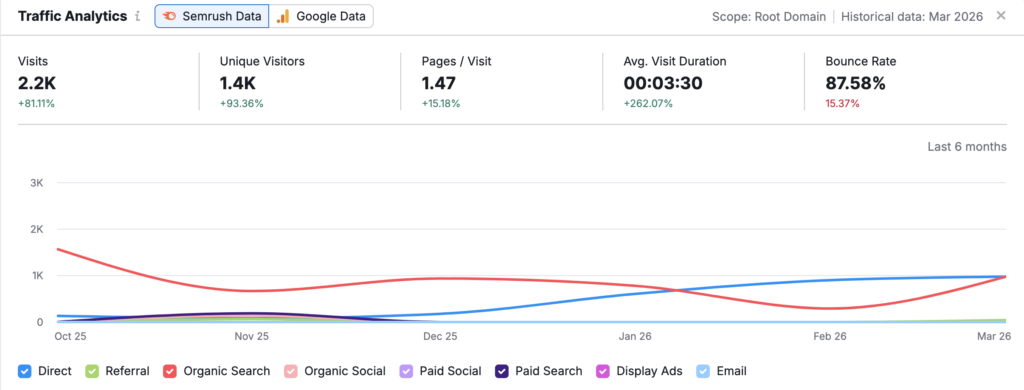
The red line shows you the amount of traffic this MSP was getting. In October, there were almost 1.6K unique visitors.
Traffic volume looks great.
But the MSP was not getting any hot leads. Zero enquiries.
I started writing for this client in October 2025.
Notice how the red line has gone down by about 600 visitors in six months. On the surface, lower traffic volumes don’t look great.
Yet you can see the number of total visits has gone up by 81.11% and unique visits by 93.36%. The average time spent on the website had also increased by 262.07%
You may be wondering how the graph appears to show a decline in numbers but the numbers show an increase in traffic.
Look at the blue line.
This is the most important metric.
In October 2025, the blue line is below 100. In March 2026, it had increased by almost 900%.
What does that blue line represent?
Direct visits.
Otherwise known as return visitors.
The blue line also explains the significant uptick in dwell time.
Why do visitors return?
Because they like your content. You offered value. They trust you to provide more value.
This is how you nurture visitors and convert them into leads.
You develop a relationship.
When you develop a relationship, you build trust and, eventually, become partners.
It’s the perfect love story, Bunny.

We need to fix our lead generation, but what’s the right approach?
Now you know that converting visitors into high-quality leads relies on offering value and building trust, the obvious next question is, how?
I knew you would want to know.
Do you remember when I mentioned the client journey follows an ACDC format? Awareness — Consideration — Decision — Client retention
Improving lead generation involves meeting decision makers at each point of the journey.
Awareness pieces demonstrate your knowledge and expertise. They are thought leadership content, problem-solution and social media posts that are relevant to their business.
These are the posts that capture your audience. But rather than throwing your net as wide as possible — and attract high volumes of traffic with low intent — focus on content that is relevant to your audience.
Relevant content answers specific questions.
When you know who your preferred ideal client is, you know the problem, pain points and frustrations they experience.
You know their fears.
You know their ambitions.
Talk to them. Answer them. Soothe them.
This is what value looks like. If you can, solving somebody’s problem because they found you through a Google search, imagine how much you can help them grow their business.
You can prove that by publishing relevant content that provides real value and builds trust.
This puts you into the consideration category and possibly (probably) the decision to be appointed as their trusted IT partner.
Business owners are not struggling to find MSPs. They are struggling to know which MSPs they can actually trust.
Earning trust and your cold leads heat up pretty quickly. By the time they contact you, the relationship has already begun.
That is what high-quality lead generation actually looks like. It is driven by value and personality. You don’t get that with paid advertising that evaporates the moment the budget stops.

Can content marketing actually deliver ROI, or is this another expense?
I totally understand why this question is a priority for decision makers.
The honest answer is yes, and no.
Yes — if you have a content marketing strategy described above.
And no — if you don’t.
There’s also another reason why a content marketing strategy will fail.
I know you’re going to roll your eyeballs and leave when I say, so hear me out because I do have a valid reason.
And no, it’s not because I am a professional content writer.
It’s because I’m a professional content writer who uses generative AI content assistants — so I know how bad they are and I can see the silent damage they are capable of.
Yes, I did say that. In my opinion, AI will not only damage your content marketing strategy, but it could also damage the future of your business.
The reason I believe AI will damage your business is because you can’t trust the content that AI produces.
For more information, read the conversation I had with AI about how Language Learning Machines (LLM) source content.
To save you the trouble of reading another article, AI admitted it generates responses based on probabilities, and although it can sound believable, it may not be accurate.
Here’s a snippet to show you I’m not making this up.
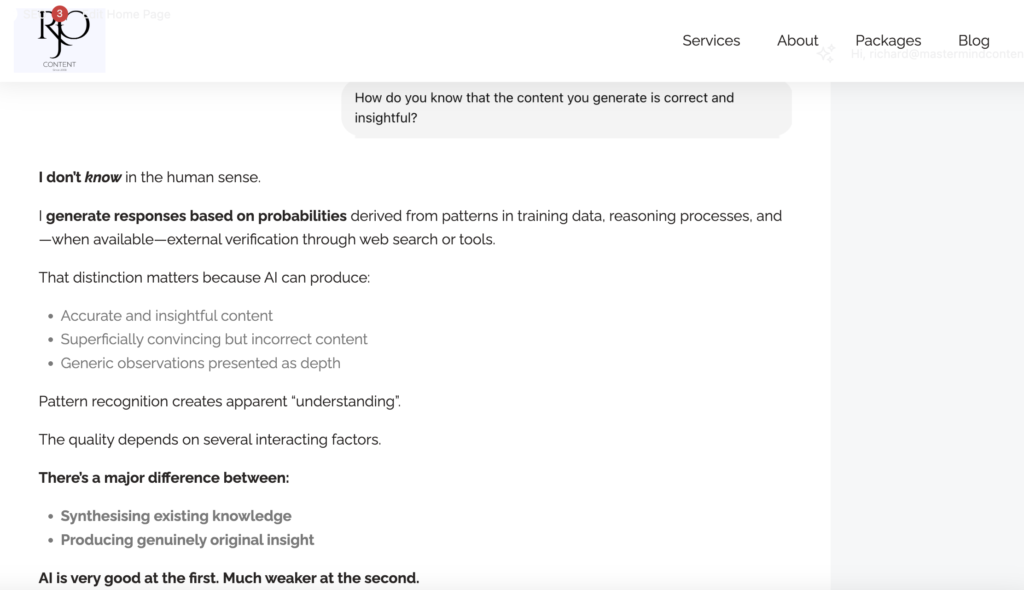
I’d like to draw your attention to the point Chat makes about LLM content being “superficially convincing, but incorrect…”
That should be a concern for multiple reasons. But let’s not get political.
The second reason I believe AI-generated content will damage your content marketing strategy is because it takes content from other sources around the web.
At best, ripping off other people’s content will be penalised by Google’s no duplicate content policy.
You can use AI to draft your content, but to avoid Google flagging it up as duplicate content, it needs to be edited.
Sometimes, heavily editing because the content is so drab you would be embarrassed to publish it.
Oh, and ideally, fuse in your brand personality.
A case in point here, if I may: AI-generated content is currently the subject of court debate in the UK and the US. The question to be answered is whether AI models breach intellectual copyright laws.
Copyright infringement is a grey area at the best of times. AI developers like Google, Microsoft and OpenAI are pushing the courts to determine that the content produced by AI models is “fair use.”
The determination of “copyright infringement” often hinges on whether intellectual property has been sufficiently altered, or whether it more or less resembles the original.

From my experience, AI infringes copyright by altering one or two words.
I expect the decision will go in favour of the Big Tech companies who argue their language models require intense training which can only be efficient by acquiring publicly available data — the majority of which is subject to copyright laws that protect intellectual property.
Google, Microsoft and OpenAI et al, are twisting the arms of judges. They argue that curbing their access to copyrighted materials will slow down innovation — and pave the way for China and Russia to win the technology race.
Yeeeah, National Security. That old chestnut.
My guess is that the perpetrator corporations will get their way and be given a license to steal intellectual property.
Including yours.
But the copyright owners with financial muscle will want some compensation, surely.
Who will they come after?
You!
That’s right, you!
Unless you adapt the stolen content with your personality flavour and the odd opinion or two. Make the content yours and it won’t be considered a copyright infringement.
AI-generated content will only be deemed to be fair use if you have permission from the owner, you credit the owner, or a significant number of changes have been made for the work to be considered original.
In answer to the question: can content marketing deliver ROI?
Not with AI-generated content, no.
And not with a content marketing strategy that drives low-quality traffic and vanity metrics.
But yes, content marketing can deliver ROI if your strategy addresses the ACDC pathway, bursts with brand personality, and you give it time to bloom.

Should we handle this internally or bring in external expertise?
The wise choice is to handle content marketing internally.
Yes, seriously. I believe that is a true statement.
Somebody who knows your business and can explain how you deliver value to your customers will produce the best content.
The question to answer here is whether or not you can afford to hire an in-house content writer.
An employee comes with overheads: salary, benefits, and materials. Potential sick pay and parental leave are employment rights that can create a burden on your payroll.
If an employee’s remuneration package is costing you more than £750 a month, you’re overpaying for content marketing.
The alternative is to get one of your tech guys to write the content for you.
If they can write without boring the bejesus out of the reader, it’s a good option.
You also have to allow them a reasonable amount of time to produce blogs and posts. Which means giving them time of tech responsibilities.
Content marketing is almost always the first thing to be deprioritised when it’s all hands on deck putting out fires.
For content marketing to gain momentum and ultimately to work, you need time, consistency, and the ability to write engaging content.

Translating technical expertise into content that resonates with non-technical decision-makers is a skill.
AI can bridge some of the skill gap, of course, but you also run the risk of inviting all the problems AI-generated content brings to your doorstep.
AI is the answer, right? It’s free.
Except it’s not free.
I’ve already explained above why AI is not a content marketing solution in the question above. You can also read why generative AI tools could do more harm than good in this article: I asked Chat GPT how AI generates content — and if it can be trusted.
Short answer. No.
Next question.
Which marketers actually understand MSPs like us?
Fewer than you would hope — and that’s not a flippant answer.
The MSP market has a very specific commercial reality. Your buyers are not marketing professionals or particularly tech-minded. The reality is, they’re not even technology enthusiasts and find IT a pain in the Arsenal.
They are business owners and operations directors who are time-poor, risk-averse, and deeply sceptical of being sold duff services.
How many times have you been burned by companies promising the earth and delivering useless dirt?
So has everybody else, Bunny.
There is a growing lack of trust amongst today’s consumers.
Business owners are not going to trust generic cybersecurity fear-mongering or the promise of a 99.999% network uptime.
They demand to know how you plan to ensure their data is protected, how they can be more productive and how much money you will save or earn for them.

Content marketing works for MSPs when you demonstrate the value you offer businesses before they even become your customer.
Earn their trust.
Your content marketer needs to understand your audience.
They need to know what solutions you provide that prevent the problems and pain points your preferred ideal customer experiences.
And they need to understand the questions being asked on a typical ACDC path.
Nobody can know everything. I’m certainly not going to claim I can do that for you. I don’t know who your audience is yet.
What I do have is a system that enables me to find all this out, and working alongside you as a content marketing partner, we can create a strategy that converts clicks into clients.
The way to win at content marketing is genuine industry knowledge, strategic content thinking, and the ability to write engaging content that bursts with personality.
Any Questions?
Let me know in the comments if you have any questions.
Or if you want to know more about my content marketing strategy, complete the contact form below to schedule a free 30-minute meeting to discover if we are a good fit for one another.
No Responses