
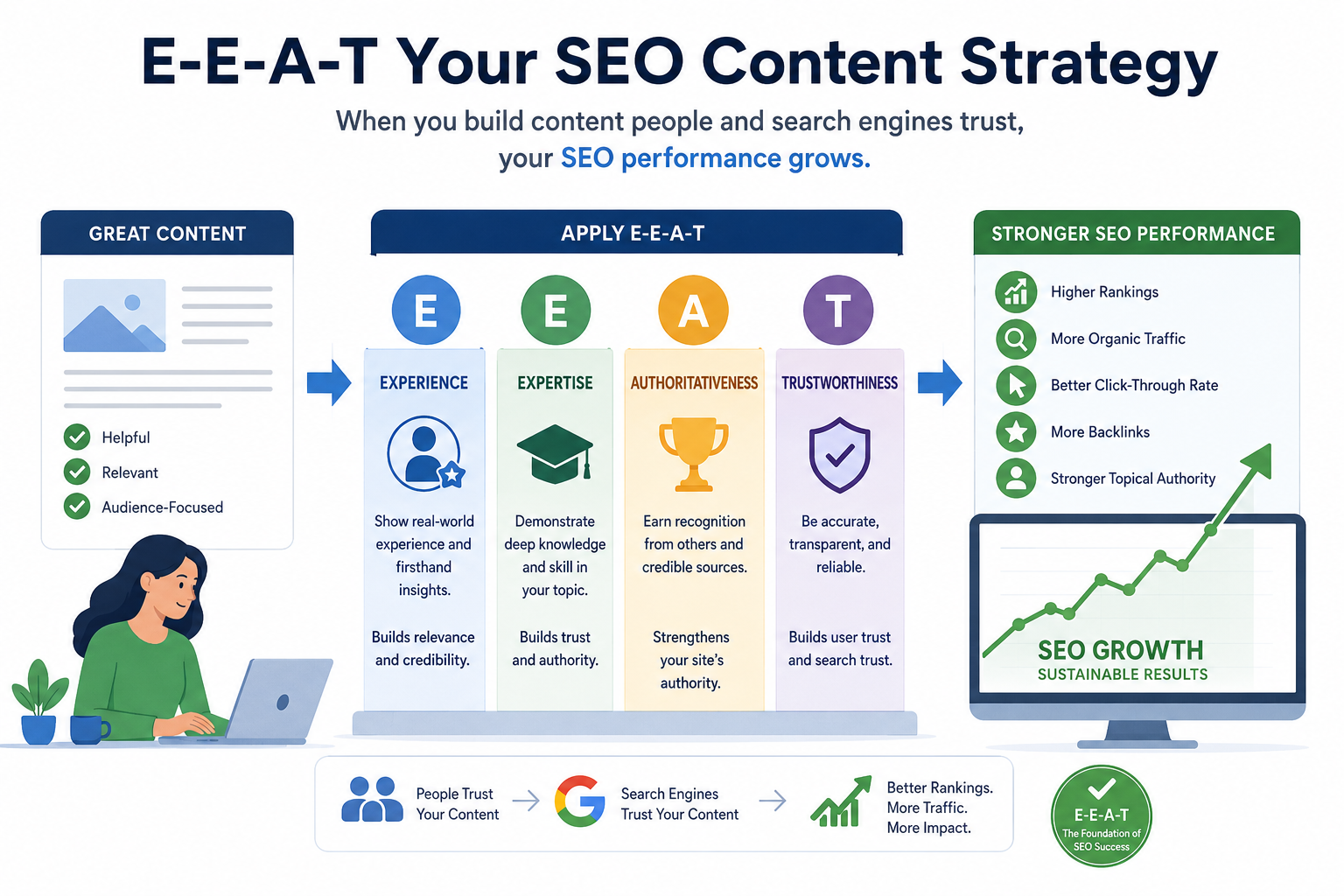
This article explains Google’s E-E-A-T: What it is, why it matters, and how your SEO Content strategy can nail every single one.
Because if you’re anything like me, you’re interested to know how Google’s ranking strategy works, right?
How can your content rank higher than your competitors?
Google, now infamous, E-E-A-T strategy is a good place to start. If your SEO content strategy is not meeting these four conditions, search engine algorithms won’t promote your website.
What Is E-E-A-T?
E-E-A-T stands for Experience, Expertise, Authoritativeness, and Trustworthiness.
It comes directly from Google’s Search Quality Rater Guidelines — the document that Google’s human quality raters use to evaluate whether search results actually serve end users.
How does E-E-A-T affect your SEO Content Strategy?
Here’s the key: E-E-A-T is not a direct ranking algorithm.
Google doesn’t assign you an E-E-A-T score and adjust your rankings accordingly. What it does is shape the principles behind how Google’s algorithms are designed and refined.
Think of it as the values Google is trying to encode into its ranking systems.
Get E-E-A-T right and your SEO content strategy naturally aligns with what Google is trying to achieve: positioning genuinely useful, credible content in front of people who need it.
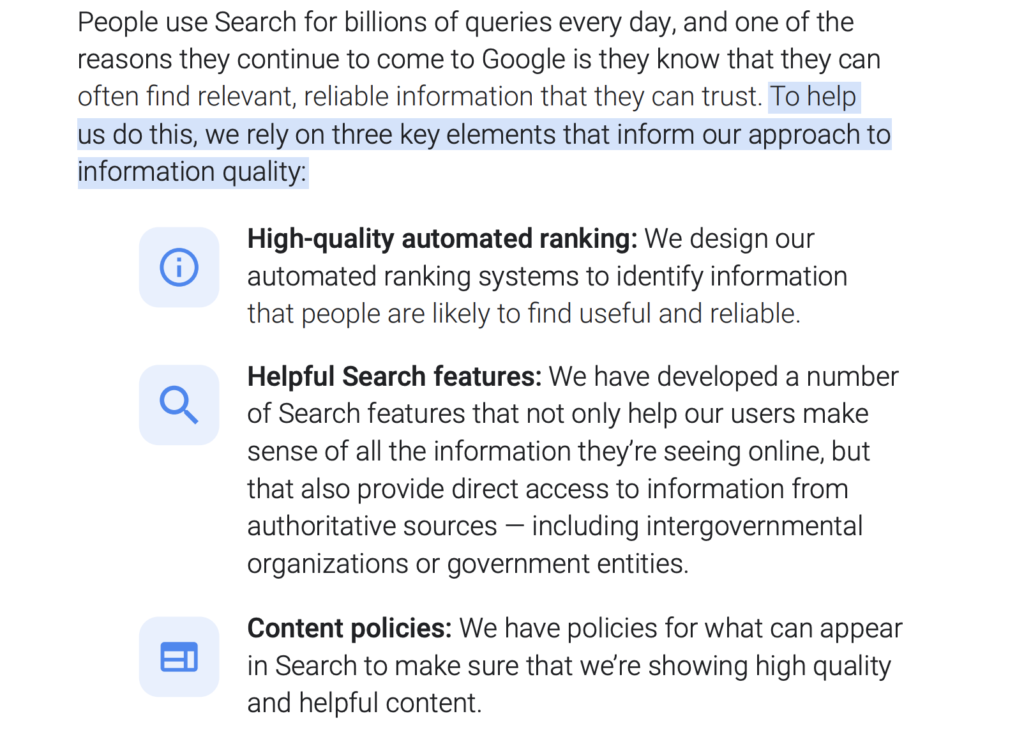
Why E-E-A-T Matters More Than Ever
Two words: AI overviews.
The explosion of AI-generated content has flooded the internet with technically competent, but mediocre writing.
Unless AI content is sufficiently edited, it does not offer genuine value to readers.
And now readers are becoming accustomed to how AI content looks and sounds, they don’t hang about.
The result?
High bounce rates.
Google has responded by doubling down by ranking content higher if it demonstrates real human experience, genuine expertise, and writing credibility.
Google’s raters, for example, add more weight to webpages if the “Main Content… is high quality [and] takes a significant amount of effort, originality, and talent or skill to create the content.”
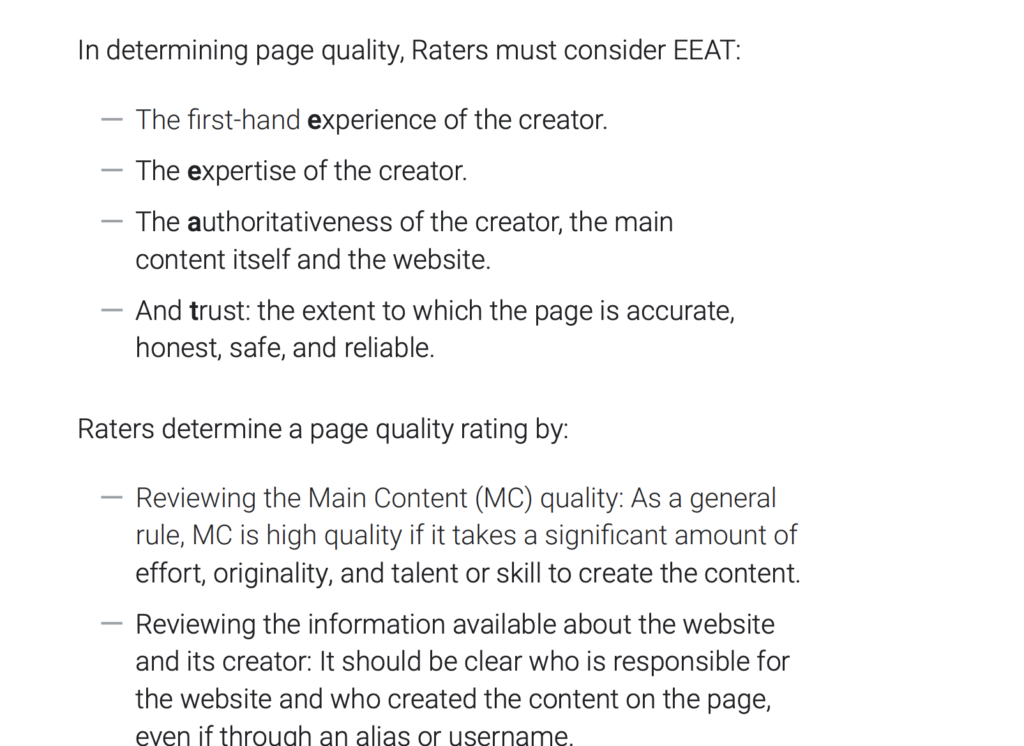
In other words, E-E-A-T is the foundation of your SEO content strategy. The content you put out has to demonstrate — convincingly and consistently — that a real, knowledgeable, and trustworthy organisation published it.
E-E-A-T is Google’s answer to the question: “How do we tell the difference between content that genuinely helps people and content that just looks like it does?”
Can readers or Google trust AI-generated content?
This is a burning question. Most people would say, of course, we can. AI knows everything.
However, when I asked AI how it sources content, and whether the content it produces is accurate and trustworthy, it basically said, not really.
AI admits to producing content that sounds trustworthy, but is not always correct.
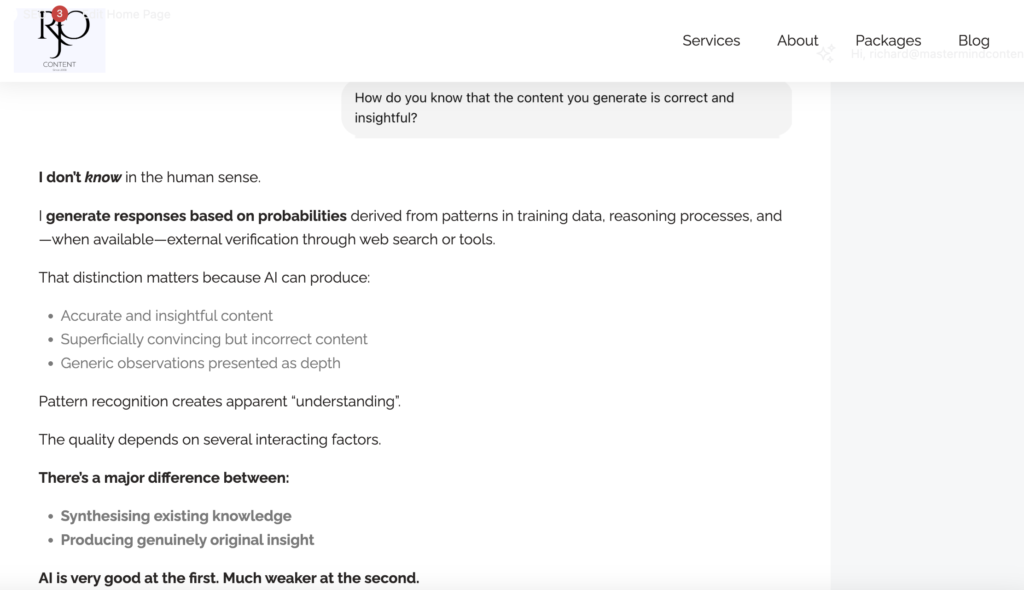
If search engine algorithms learn to detect this, what do you think will happen to AI-generated content?
Correct: It will become invisible.
That’s not to say, you shouldn’t use AI. Just make sure you read it through carefully, and edit it heavily.
If you want to know why you can’t trust AI content, read the entire conversation I had with ChatGPT: I Asked ChatGPT About AI-Generated Content. This Was The Reply!
Putting The E in SEO Content Strategy: Experience
Google’s original format was EAT. In 2014, the search engine behemoth added a second E — Experience. The addition changed everything.
Google now distinguishes between someone who knows about a topic and someone who has lived it.
Experience means first-hand, real-world engagement with the subject matter.
For example, a travel writer who has actually visited a destination compared to a content writer who has researched it and taken bits of information from other websites.
The latter is typically how most content writers have to work. With 20 years experience as copywriter behind me, I can tell you first-hand that the majority of content on the internet is not original and lacks Experience Google wants to promote.
Likewise, Google will position a mechanic with twenty years of experience working with cars, over a mechanic just starting out.
Whilst that may not seem fair to the start-up mechanic, that’s just the way business is in the real-world anyway.

Why does Google care about your Experience?
Anyone can research a topic and write something that sounds credible.
AI can certainly rustle something up, and to the uninformed reader, any information they take on board is believable.
The best information comes from lived experience.
First-hand experience produces insights, nuances, and perspectives that research alone cannot replicate. Google’s algorithms are increasingly sophisticated at detecting the difference.
How does your SEO Content Strategy demonstrate Experience?
1. Write from a first-person perspective and share real stories.
Share specific outcomes, real client situations (anonymised where necessary), genuine failures and what you learned from them.
Vague generalities signal inexperience. Specific, contextualised insight signals the real thing.
2. Include original data and observations.
Your own client results, patterns you’ve noticed over time, and original perspectives rooted in direct experience are things nobody else can replicate — which makes them both credible and unique.
3. Use case studies.
Real examples of work you’ve done, problems you’ve solved, and results you’ve achieved are among the most powerful experience signals you can include in an SEO content strategy.
They demonstrate that your knowledge has been tested in the real world and found to be reliable.
4. Author bios that reflect real experience.
“John has fifteen years of hands-on experience working with SMEs across the Midlands” does more for your E-E-A-T than a generic bio that could belong to anyone.
5. Demonstrate Your Expertise
Google’s second E in the E-E-A-T model is Expertise — the depth of knowledge you can demonstrate in your field.
It’s the difference between someone who is learning about a subject and someone who has mastered it.
Google evaluates expertise differently depending on the topic. For YMYL content — “Your Money or Your Life” topics like health, finance, and legal advice — the bar is extremely high.
Misinformation in these areas can cause real-world harm, so Google is understandably strict. For other topics, demonstrated knowledge and consistent quality still matter, even if the threshold is lower.
Why Google cares:
To put it bluntly, the internet is full of confidently written nonsense.
And AI scrapes the internet to put its piece together. Nonsense breeds nonsense.
Expertise signals help Google separate the people who actually know what they’re talking about from the people who are very good at sounding like they do.

How Your SEO Content Strategy Demonstrates Expertise
1. Go deep, not just broad.
Surface-level overviews that could have been written by anyone signal low expertise.
An SEO content strategy built around genuinely in-depth, specific, accurate content signals knowledge, not nonsense.
Cover topics thoroughly. Answer follow-up questions before they’re asked.
2. Use the right language naturally.
Genuine experts use industry-specific terminology correctly and contextually — not to show off, but because it’s the most precise way to communicate.
Your content should reflect the vocabulary of your field without becoming impenetrable. The best use of this is to make a passing reference to industry-specific terminology within the explanation.
For example, placing relevant keywords throughout your content informs search engines what the main topic of your page is. This is known as optimisation.
Do you see how I demonstrate expertise to Google and the reader by explaining in simple terms what optimisation means?
Experts can explain complex topics in simple terms.
3. Show your reasoning.
Experts don’t just state conclusions — they explain how they arrived at them.
Walking readers through your thinking process demonstrates mastery in a way that bullet points and definitions cannot.
4. Credentials and qualifications.
If you have formal qualifications, professional memberships, or industry accreditations, they belong on your website — on author pages, about pages, and service pages.
They don’t guarantee expertise, but they are legitimate supporting signals.
5. Consistent publishing on a specific topic.
An SEO content strategy built around a clearly defined niche builds topical authority over time.
Google recognises “expertise” on websites that consistently produce high-quality content on a specific subject area.
Don’t worry about regenerating the same content. Repurposing — or rewriting — an earlier blog is a good way to add content regularly in less time and less cost.
6. Authoritativeness
Authority is what happens when expertise becomes reputation.
This metric determines how well-regarded you are within your industry or niche — not just by Google, but by other credible sources, organisations, and people in your field.
Authority is largely about what other people say about you rather than what you say about yourself.
This is what makes it the most difficult component of E-E-A-T to manufacture — and the most valuable when it’s genuine.
Why Google cares:
Anyone can claim to be an authority. External signals — who links to you, who mentions you, who cites your work — are far harder to fake than on-page content.

How Your SEO Content Strategy Builds Authoritativeness
1. Earn backlinks from credible sources.
A strong SEO content strategy creates content worth linking to — original research, genuinely useful guides, and thought leadership pieces that industry publications, journalists, and other websites want to reference.
One link from a respected industry publication does more for your authority than fifty links from low-quality directories.
2. Get featured and quoted.
Contributing to industry publications, being interviewed on podcasts, appearing as a guest expert, and being quoted in journalism all build external authority signals.
Your SEO content strategy should create the reputation that makes people want to feature you.
3. Build topical authority through content clusters.
Rather than publishing isolated articles, structure your SEO content strategy around pillar content — comprehensive, authoritative pages on core topics — supported by clusters of related articles that link back to them.
For example, my pillar page is a content strategy to help MSPs drive more conversions and has the heading: How I Help MSPs Increase Qualified Leads By Over 900%
A pillar page should be in-depth, ideally around 5000 words and take readers through a step-by-step process.
Choose a topic people want to know about, but can’t really do themselves.
This strategy signals to Google that your website is the definitive resource on a subject, not just a site that happened to write about it once.
Therefore, Google ranks it higher, and thus your SEO content strategy is more effective.
4. Reviews and reputation signals.
Google Reviews, Trustpilot, industry-specific review platforms — these feed into how Google perceives your authority and trustworthiness.
Actively collecting genuine reviews from satisfied clients is a legitimate and important part of the picture.
5. Trustworthiness
Trust is the foundation that holds the entire E-E-A-T framework together.
Google explicitly describes it as the most important component — the one that all the others ultimately serve.
You can have experience, expertise, and authority, but if your website gives users reason to doubt your integrity, credibility, or reliability, those other signals are undermined.
Trustworthiness operates on multiple levels: the accuracy of your content, the transparency of your identity, the security and professionalism of your website, and the consistency between what you claim and what you deliver.
Why Google cares:
Trust is ultimately what search is built on. If users can’t trust the results Google serves them, they stop using Google.
Every element of E-E-A-T is, in the end, in service of the fundamental question: can this website be trusted?

How Your SEO Content Strategy Builds Trustworthiness
1. Be accurate and honest.
This sounds obvious yet consistently underestimated.
Fact-check your content.
An SEO content strategy built on accurate, carefully researched content builds the kind of trust that endures algorithmic updates.
Update outdated articles when information changes. Acknowledge what you don’t know.
2. Transparency about who you are.
Real businesses with real people behind them. Genuine contact information.
Clear about pages that explain who you are, what you do, and why. Hiding your identity — or being vague about it — is an immediate trust signal in the wrong direction.
3. Technical trust signals.
HTTPS security, a professional and functional website design, fast load times, no broken links, and clear privacy policies all contribute to Google’s assessment of your site as trustworthy infrastructure.
4. Editorial standards.
If you publish content that cites sources, those sources should be credible and verifiable.
If you make claims, they should be substantiated.
An SEO content strategy that treats accuracy as non-negotiable builds cumulative trust with both Google and readers over time.
5. Consistency.
Trust is built through repeated positive experiences.
Websites that publish consistently, maintain quality standards, and deliver on what it promises — rather than lurching between brilliant content and obvious filler — compound trust in a way that sporadic effort never can.
Putting It All Together: An SEO Content Strategy Built for E-E-A-T
Here’s what a properly structured SEO content strategy looks like when E-E-A-T is the organising principle:
Foundation layer:
A website that is technically sound, transparent about its identity, clearly defines its niche, and gives every signal of being a legitimate, professional operation.
Content layer:
A consistent publishing programme built around search terms your ideal audience is putting into search engines.
Go deep on topics. Demonstrate your experience and expertise
Authority layer:
Outreach, relationship-building, and original content creation that earns external recognition — backlinks, features, citations, and reviews from credible sources in your industry.
Trust layer:
Editorial rigour, factual accuracy, source citation, and a consistent commitment to putting genuine value ahead of search performance — because ironically, that’s precisely what produces the best long-term search performance.
Need Help With Your E-E-A-T SEO Content Strategy
E-E-A-T isn’t a checklist you complete once and forget. It’s a standard that your SEO content strategy either meets — consistently, over time — or it doesn’t.
The good news is that if you’re genuinely good at what you do, genuinely committed to helping your audience, and willing to build your SEO content strategy around search engine algorithms, E-E-A-T is not a hurdle.
It’s an opportunity.
If you need any help building and executing an SEO content strategy, get in touch by completing the form below.
No Responses